Thermal Fogging & Air Scrubbing Services in Bayville (11709) – Experienced Team from 1800 Water Damage of Nassau County
In the charming locale of Bayville (11709), nestled in the heart of Nassau County, a unique service is making waves - Thermal Fogging & Air Scrubbing Services! Offered by the experienced team from 1800 Water Damage of Nassau County, these services are not just about cleaning; theyre about transforming the very air we breathe. You might wonder, why would anyone need such services? Well, lets delve into that.
First off, its crucial to understand what thermal fogging and air scrubbing entail.
* “dehumidification system”
* odor control after fire
Thermal fogging is a process that employs heat to create a fog-like mist of cleaning solution. This mist penetrates even the most stubborn nooks and crannies, reaching places conventional cleaning methods simply cant (or wont!). Its particularly effective after events like fires, where odors and residues can linger long after the flames have been extinguished. On the other hand, air scrubbing involves using high-efficiency particulate air (HEPA) filters to purify the air, removing contaminants and allergens that could be detrimental to our health.
Now, you might think, Do I really need such services? The answer isnt always a resounding yes. * “dehumidification system” Not every situation calls for such intensive cleaning methods. However, in environments where air quality is compromised, these services can be a game-changer. They dont just remove visible dirt and debris; they tackle the invisible pollutants that could be lurking in your home or business.
The team from 1800 Water Damage of Nassau County takes pride in their expertise. Theyre not just a bunch of folks with cleaning equipment; theyre trained professionals who understand the science behind what they do. Their experience allows them to assess each situation uniquely, ensuring that the methods applied are tailored to the specific needs of the space. Its not a one-size-fits-all approach, and thats what makes their service stand out.
But lets not get too technical. The real question is, how does this impact you? Well, imagine walking into a room that smells fresh and feels clean, knowing that the air you breathe is free from harmful pollutants. Its not just about aesthetics; its about creating a healthier environment for you and your loved ones. And in todays world, where were increasingly aware of the air qualitys impact on health, thats no small thing.
However, its worth noting that these services arent a magical fix for all air quality issues. They work best when combined with other practices, like regular cleaning and maintenance. So, dont expect miracles if youre not willing to do your part in maintaining a clean space.
In conclusion, Thermal Fogging & Air Scrubbing Services from 1800 Water Damage of Nassau County offer more than just a clean space. Fire & Soot Cleanup in East Williston (11596) – Trust 1800 Water Damage of Nassau County . They provide peace of mind, knowing that your environment is as healthy as it can be. With their experienced team at the helm, residents and businesses in Bayville can breathe a little easier (literally!). * odor control after fire So, if youre in the area and wondering whether these services are right for you, why not give them a try? You might be surprised at the difference it makes.
Albany County (/ˈɔːlbəni/ⓘAWL-bə-nee) is a county in the state of New York, United States. Its northern border is formed by the Mohawk River, at its confluence with the Hudson River, which is to the east. As of the 2020 United States Census, the population was 314,848.[2] The county seat and largest city is Albany,[3] which is also the state capital of New York. As originally established by the English government in the colonial era, Albany County had an indefinite amount of land, but has had an area of 530 square miles (1,400 km2) since March 3, 1888. The county is named for the Duke of York and of Albany, who became James II of England (James VII of Scotland). The county is part of the Capital District region of the state.
After England took control of the colony of New Netherland from the Dutch, Albany County was created on November 1, 1683,[a] by New York GovernorThomas Dongan, and confirmed on October 1, 1691.[4] The act creating the county vaguely defined its territory "to containe the Towns of Albany, the Collony Rensselaerwyck, Schonecteda, and all the villages, neighborhoods, and Christian Plantaçons on the east side of Hudson River from Roelef's Creek, and on the west side from Sawyer's Creek (Saugerties) to the Sarraghtoga."[5] The confirmation declared in 1691 was similar but omitted the Town of Albany, substituted "Mannor of Ranselaerswyck" for "Collony Rensselaerwyck", and stated "to the uttermost end of Sarraghtoga" instead of just "to Sarraghtoga". Livingston Manor was annexed to Albany County from Dutchess County in 1717.[5]
Albany's boundaries were defined more closely as state statutes would add land to the county, or more commonly subtract land for the formation of new counties.[6] In 1772 with the creation of Tryon and Charlotte counties, Albany gained definitive boundaries and included what are now Albany, Columbia, Rensselaer, Saratoga, and Schenectady counties; large parts of Greene and Washington counties; and the disputed southwest corner of Vermont.[7][a]
The city of Albany was the first municipality within this large county,[6] founded as the village (dorp in Dutch) of Beverwyck by the Director-General of New Amsterdam, Pieter Stuyvesant, who also established the first court in Albany.[8] Albany was established as a city in 1686 by Governor Dongan through the Dongan Charter after the English took over the colony.[6]Schenectady to the west was given a patent with some municipal rights in 1684 and became a borough in 1765.[7]
The Manor of Rensselaerswyck was created as a district within the county in 1772, and later divided into two districts, one on each side of the Hudson River in 1779. The west district included all of what is now Albany County other than lands were in the city of Albany at the time.[9] Though the Manor of Rensselaerswyck was the only district (along with the city of Albany) in what is today Albany County, it was not the only district in what was Albany County at the time. Pittstown in 1761, and Duanesburgh in 1764, were created as townships. But when districts were created in 1772, those townships were incorporated into new districts, Pittstown in Schaghticoke and Duanesburgh into the United Districts of Duanesburgh and Schoharie.[7] Schenectady was also made from a borough to a district in 1772.[10] Other districts established in 1772 were Hoosick, Coxsackie, Cambridge, Saratoga, Halfmoon, Kinderhook, Kings, Claverack, Great Imboght, and the Manor of Livingston.
In a census of 1697, there were 1,452 individuals living in Albany County; two years later it would be counted as 2,016 at the beginning of King William's War. By the end of the war in 1698, the population had dropped to 1,482, but rebounded quickly and was at 2,273 by 1703. By 1723, it had increased to 6,501 and in 1731 to 8,573, which was slightly less than the population of the city of New York in the same year. In 1737, the inhabitants of Albany County would outnumber those of New York County by 17 people. In 1774, Albany County, with 42,706 people, was the largest county in colonial New York. According to the first Federal Census in 1790, Albany County reached 75,921 inhabitants and was still the state's largest county.[11]
On March 7, 1788, the state of New York divided the entire state into towns eliminating districts as administrative units by passing New York Laws of 1788, Chapters 63 and 64.[12]
On July 20, 1764, King George III established the boundary between New Hampshire and New York along the west bank of the Connecticut River, north of Massachusetts and south of the parallel of 45 degrees north latitude. Albany County implicitly gained present-day Vermont. Although disputes occasionally broke out later, this line became the boundary between New Hampshire and Vermont, and has remained unchanged to the present. When New York refused to recognize land titles through the New Hampshire Grants (towns created earlier by New Hampshire in present Vermont), dissatisfied colonists organized in opposition, which led to the creation of independent Vermont in 1777.[17]
On March 12, 1772, Albany County was partitioned again, this time into the counties of Albany, Tryon (now Montgomery), and Charlotte (now Washington). This established a definite area for Albany County of 5,470 sq mi (14,200 km2).[22]
On March 24, 1772, Albany County was partitioned again, with an additional 50 square miles (130 km2) handed over to Cumberland County.[23]
On March 9, 1774, Albany County was partitioned again, this time passing 1,090 square miles (2,800 km2) to Ulster County.[24]
On April 1, 1775, Albany was again partitioned, this time giving up 60 square miles (160 km2) to Charlotte County, who then exchanged this land with a like parcel in Cumberland County.[25]
On January 15, 1777, Albany County was again partitioned, this time on account of the independence of Vermont from New York, reducing Albany County by an additional 300 square miles (780 km2).[26]
On June 26, 1781, Bennington County, Vermont, attempted to annex a portion of Albany County that today includes portions of Washington and Rensselaer counties to form what they called "The West Union".[27] The fledgling United States – under the Articles of Confederation – arbitrated this annexation, and condemned it, resulting in Vermont ceasing the annexation on 1782-02-23.[28]
On April 4, 1786, Columbia County was created from 650 square miles (1,700 km2) of Albany County land.[29]
On March 7, 1788, New York, refusing to recognize the independence of Vermont, and the attendant elimination of Cumberland County, attempted to adjust the line that separated Cumberland from Albany County in present-day Vermont, but to no effect.[30]
On February 7, 1791, Albany County was partitioned again, this time to form Rensselaer and Saratoga counties. Rensselaer received 660 square miles (1,700 km2), while Saratoga received 850 square miles (2,200 km2). Also the town of Cambridge was transferred to Washington County. A total of 1,680 square miles (4,400 km2) changed hands.[31]
On June 1, 1795, Albany County was once again partitioned, this time losing 460 sq mi (1,200 km2) to Schoharie County.[32]
On April 5, 1798, another partition took place, with 90 square miles (230 km2) passing to Ulster County.[33]
On March 25, 1800, once again Albany County was partitioned, with 360 square miles (930 km2) being used to create Greene County.[34]
On April 3, 1801, all New York counties were redefined, with Albany County gaining 10 sq mi (26 km2).[35]
On March 7, 1809, Schenectady County was created from 230 square miles (600 km2) of Albany County land,[36] reducing Albany County to its current size.[14]
According to the U.S. Census Bureau, the county has an area of 533 square miles (1,380 km2), of which 523 square miles (1,350 km2) is land and 10 square miles (26 km2) (2.0%) is water.[38]
Albany County is in east central New York, extending southward and westward from where the Mohawk River joins the Hudson River. Its eastern boundary is the Hudson; a portion of its northern boundary is the Mohawk.
The terrain of the county ranges from flat near the Hudson and Mohawk Rivers to high and hilly to the southwest, of the Helderberg Escarpment and the Helderberg Mountains. The highest point is one of several summits near Henry Hill at approximately 2,160 feet (660 m) above sea level; The lowest point is 62 feet (19 m) above sea level at the Hudson River's southernmost extent in the county.
█ Average max. and min. temperatures in °F█ Precipitation totals in inchesSource: ustravelweather.com[39]
Metric conversion
J
F
M
A
M
J
J
A
S
O
N
D
69
0
−10
58
1
−9
81
7
−4
83
14
2
93
21
8
95
25
13
89
28
16
93
27
15
84
22
10
82
15
4
84
9
−1
70
2
−7
█ Average max. and min. temperatures in °C
█ Precipitation totals in mm
The Capital District has a humid continentalclimate, with cold, snowy winters, and hot, wet summers. Albany receives around 36.2 inches (920 mm) of rain per year, with 135 days of at least 0.01 inches (0.25 mm) of precipitation. Snowfall is significant, totaling about 63 inches (1,600 mm) annually,[40] but with less accumulation than the lake-effect areas to the north and west, being far enough from Lake Ontario. Albany County is however, close enough to the coast to receive heavy snow from Nor'easters, and the region gets the bulk of its yearly snowfall from these types of storms. The county also occasionally receives Alberta clippers. Winters are often very cold with fluctuating conditions, temperatures often drop to below 0 °F (−18 °C) at night. Summers in the Albany can contain stretches of excessive heat and humidity, with temperatures above 90 °F (32 °C) and dew points near 70. Severe thunderstorms are common but tornadoes are rare. Albany receives on average per year 69 sunny days, 111 partly cloudy days, and 185 cloudy days;[41] and an average, over the course of a year, of less than four hours of sunshine per day, with just over an average of 2.5 hours per day over the course of the winter.[42] The chance during daylight hours of sunshine is 53%, with the highest percentage of sunny daylight hours being in July with 64%, and the lowest month is November with 37%.[40]
Albany County has myriad different architectural styles spanning centuries of development.[43] Within the city of Albany alone there is Dutch Colonial (the Quackenbush House), French Renaissance (the New York State Capitol), Federal style (the original Albany Academy in Academy Park), Romanesque Revival (Albany City Hall), Art deco (the Alfred E. Smith Building), and Modern (Empire State Plaza). The cities of Albany, Cohoes, and Watervliet and the village of Green Island are more urban in architecture; while the towns of Colonie, Guilderland, New Scotland, and Bethlehem more suburban and the remaining Hilltowns (Berne, Knox, Westerlo, and Rensselaerville) very rural.
A bronze statue of the famous Scottish poet Robert Burns sculpted by Charles Calverley in 1888. This structure is located in the Washington Park neighborhood of Albany, New York.
Albany County is home to the Emma Treadwell Thacher Nature Center, which opened in July 2001 and is near the shore of Thompson's Lake between the two state parks that are in Albany County- Thompson's Lake State Park and John Boyd Thacher State Park. There are also state-owned nature preserves with interactive educational programs such as the Five Rivers Environmental Education Center and the Albany Pine Bush. The cities, towns, and villages of Albany County have many municipal parks, playgrounds, and protected green areas. Washington Park in the city of Albany and The Crossing in the town of Colonie are two of the largest. There are many small hiking and biking trails and longer distance bike-hike trails such the Mohawk-Hudson Bike-Hike Trail which goes from the city of Albany north to Cohoes and then west along the Mohawk River to Schenectady County.
One of the largest events in Albany County is the Tulip Fest held in the city of Albany every spring at Washington Park. The tradition stems from when MayorErastus Corning 2nd had a city ordinance passed declaring the tulip as Albany's official flower on July 1, 1948.[44] The African-American tradition of Pinksterfest, whose origins are traced back even further to Dutch festivities, was later incorporated into the Tulip Fest. The Albany LatinFest has been held since 1996 and drew 10,000 to Washington Park in 2008.[45] PolishFest is a three-day celebration of Polish culture in the Capital District, held in the town of Colonie for the past eight years.[46]
Albany County has two shopping malls classified as super-regional malls (malls with over 800,000 sq ft),[47]Crossgates Mall in Guilderland and Colonie Center in Colonie with over one million square feet of rentable space in each. Huck Finn's Playland is a children's amusement park open during the summer, which started operations in the Summer of 2015—after purchasing the rides from the former Hoffman's Playland in Newtonville, which was in operation from 1951 to the Fall of 2014. During the winter there are over 18 miles (29 km) of official trails for snowshoeing at the Albany Pine Bush Preserve, in the city of Albany and towns of Colonie and Guilderland.[48]
Albany County has many historical sites and museums covering a wide range of topics and time periods. The Albany Institute of History and Art, founded in 1791, is one of the oldest museums in the United States,[49] and the New York State Museum is the country's oldest and largest state museum.[50] Many of the museums are historical sites themselves, such as Cherry Hill, the Ten Broeck Mansion, and the Schuyler Mansion in the city of Albany and the Pruyn House in Colonie. The Quackenbush House is the second oldest house in Albany and part of the Albany Heritage Area Visitors Center, which includes a planetarium. The Albany Pine Bush Discovery Center in Albany includes hands-on activities to learn about the unique Pine Bush Barrens of the Albany, Guilderland, and Colonie. Covering the history of pharmacy is the Throop Drug Store Museum at the Albany College of Pharmacy. The USS Slater, DE-766 is a World War II Destroyer Escort, the last floating Destroyer Escort, owned by the Destroyer Escort Historical Museum is moored from Spring to Fall at the foot of Quay Street in the Hudson River. The ship is open for tours each week and has a well-maintained collection of World War II US Naval artifacts.
Albany County itself owns the largest venue for performing arts in the county, the Times Union Center, which was originally built as the Knickerbocker Arena; it opened on January 30, 1990, with a performance by Frank Sinatra.[53] In 1996, The Grateful Dead released a concert album from their March 1990 performances titled Dozin' at the Knick.[54]
Many athletes and coaches in major sports have begun their careers in Albany County. Phil Jackson, former NBA head coach of the Chicago Bulls and Los Angeles Lakers won his first championship ring as a coach when he guided the Albany Patroons to the 1984 CBA championship. Three years later, the Patroons completed a 50–6 regular season, including winning all 28 of their home games; at that time, Sacramento Kings head coach George Karl was the Patroons' head coach. Future NBA stars Mario Elie and Vincent Askew were part of that season's squad. Mike Tyson received his early training in the Capital District and his first professional fight was in Albany in 1985 and Tyson's first televised fight was in Troy in 1986. He fought professionally four times in Albany and twice each in Troy and Glens Falls between 1985 and 1986.
Albany County was originally settled primarily by Protestants from northern Europe: the Netherlands, British Isles, and Germany. In the 19th century it was a destination for many Catholic immigrants, first from Ireland—fleeing the Great Famine—and later from southern Germany and central and southern Europe. Late 19th- and early 20th-century immigrants included Jews from eastern Europe. In addition to other Jewish congregations, the county has one of the few Karaite Jewish communities outside Israel.[55] This community is active and has its own synagogue.[56] The Albany Metro Area has consistently been found to be among the highest ranking postchristian cities in the US.[57]
Albany County, New York – Racial and ethnic composition Note: the US Census treats Hispanic/Latino as an ethnic category. This table excludes Latinos from the racial categories and assigns them to a separate category. Hispanics/Latinos may be of any race.
As of the 2020 US Census, there were 314,848 people in 126,540 households residing in the county.[2] The population density was 563 inhabitants per square mile (217/km2). There were 134,072 housing units at an average density of 248 units per square mile (96/km2). The racial makeup of the county was 78.2% White, 12.7% Black or African American, 0.2% Native American, 4.8% Asian, 0.0% Pacific Islander, 1.6% from other races, and 2.5% from two or more races. 4.9% of the population were Hispanic or Latino of any race. 19.2% were of Irish, 16.0% Italian, 11.0% German, 6.1% English and 5.1% Polish ancestry according to Census 2000.[71] 90.4% spoke English, 2.7% Spanish and 1.0% Italian as their first language.
There were 124,682 households, out of which 28.9% had children under the age of 18 living with them, 43.2% were married couples living together, 12.2% had a female householder with no husband present, and 41.1% were non-families. 33.0% of all households were made up of individuals, and 11.3% had someone living alone who was 65 years of age or older. The average household size was 2.32 and the average family size was 2.99.
In the county, the age distribution of the population shows 22.6% under the age of 18, 11.3% from 18 to 24, 28.8% from 25 to 44, 22.8% from 45 to 64, and 14.5% who were 65 years of age or older. The median age was 37 years. For every 100 females there were 91.7 males. For every 100 females age 18 and over, there were 87.8 males.
The median income for a household in the county was $42,935, and the median income for a family was $56,724. Males had a median income of $39,838 versus $30,127 for females. The per capita income for the county was $23,345. About 7.2% of families and 13.1% of the population were below the poverty line, including 14.9% of those under age 18 and 6.3% of those age 65 or over.
For most of its history, Albany County has predominantly backed Democratic Party presidential candidates. In only three elections since 1924 has a Republican Party candidate carried the county in a presidential election, the most recent being Richard Nixon in 1972. The Democratic Party dominance has become more pronounced in recent years, with George H. W. Bush in 1988 the most recent Republican candidate to win even forty percent of the county's vote.
United States presidential election results for Albany County, New York[75]
Albany County was governed by a board of supervisors until 1968.[76] The board consisted of the town supervisors of each town in the county, as well as county supervisors elected from the wards of each city in the county.[77] In the later years of its existence, the board used a system of weighted voting to comply with recently enacted federal and state proportional representation requirements.[78] On January 1, 1976, Albany County government was changed by a new charter establishing a county executive elected at-large, in addition to the 39-seat county legislature.[79] In the first election for county executive, Democratic nominee James J. Coyne Jr., who was then serving as county clerk, defeated Liberal nominee Theresa Cooke, county treasurer and a critic of the county and city Democratic machine run by Daniel P. O'Connell, and Republican nominee Almerin C. O'Hara, former state Commissioner of the Office of General Services.[80] Each of the 39 legislators are elected from single-member districts. As of 2023, the county legislature has 29 Democrats, 10 Republicans.[81]
The County Executive is Daniel P. McCoy. Other officials elected countywide include District Attorney Lee Kindlon, Clerk Bruce A. Hidley, Comptroller Susan A. Rizzo, and Sheriff Craig D. Apple. All county officials are Democrats. Other elected officials with districts in the county include:
The Albany County Sheriff's Office is one of the oldest law enforcement agencies in the United States, having been established in the 1660s.[84] Sheriff Craig Apple was first elected in 2011.[85]
The sheriff is also responsible for the county jail, which was built in 1931,[86] and renamed from the Albany County Correctional Facility to the Albany County Corrections and Rehabilitative Services Center in 2019.[87] It has a contract with New York City to accept prisoners from its facilities. The New York Times has reported that juveniles sent to Albany were beaten and placed in isolation, which is forbidden in New York City.[88]
Albany County has long been at the forefront of transportation technology from the days of turnpikes and plank roads to the Erie Canal, from the first passenger railroad in the state to the oldest municipal airport in the United States. Today, Interstates, Amtrak, and the Albany International Airport continue to make the Albany County a major crossroads of the Northeastern United States.
The Capital District Transportation Committee (CDTC) is the Metropolitan Planning Organization (MPO) for the Albany-Schenectady-Troy Metropolitan Statistical Area (MSA). Every metropolitan area in the United States with a population of over 50,000 must have a MPO in order to get any federal transportation funding. The US Department of Transportation (USDOT) uses an MPO to make decisions on what projects are most important to a metro area for immediate versus long term funding. The USDOT will not approve federal funds for transportation projects unless they are on an MPO's list.[91]
Since 1968 when Union Station in the city of Albany was abandoned for a new station across the Hudson in the city of Rensselaer, Albany County has been without a train station. Amtrak has several routes serving the Albany-Rensselaer Station. The Adirondack (north to Montreal, Quebec and south to the city of New York), Empire Service (west to Buffalo and Niagara Falls, south to New York), Ethan Allen Express (northeast to Rutland, Vermont and south to New York), Maple Leaf (west to Toronto and south to New York), and the Lake Shore Limited (at Albany-Rensselaer separate routes from Boston and New York merge to one train west to Chicago, on way east one train splits to two, one east to Boston and another south to New York).
^ abc"On November 1, 1683, when the State of New York was divided into ten counties, Albany was erected as one of them with an exceedingly large territory. From its area has since been taken the counties of Tryon and Charlotte, in 1772; Columbia, in 1786; Rensselaer and Saratoga, in 1791; a part of Schoharie, in 1795; a part of Greene, in 1800; and Schenectady, in 1809."[92]
Situated on western Long Island, the County of Nassau borders New York City's borough of Queens to its west, and Long Island's Suffolk County to its east. It is the most densely populated and second-most populous county in the State of New York outside of New York City, with which it maintains extensive rail and highway connectivity, and is considered one of the central counties within the New York metropolitan area.
A 2012 Forbes article based on the American Community Survey reported Nassau County as the most expensive county and one of the highest income counties in the U.S., and the most affluent in New York state, with four of the nation's top ten towns by median income located in the county.[9] As of 2024, the median home price overall in Nassau County is approximately US$800,000, while the Gold Coast of Nassau County features some of the world's most expensive real estate.
Several alternate names had been considered for the county, including "Bryant", "Matinecock" (a village within the county currently has that name), "Norfolk" (presumably because of the proximity to Suffolk County), and "Sagamore".[12] However, "Nassau" had the historical advantage of having at one time been the name of Long Island itself,[13] and was the name most mentioned after the new county was proposed in 1875.[14][15][16]
The area now designated as Nassau County was originally the eastern 70% of Queens County, one of the original twelve counties formed in 1683, and was then contained within two towns: Hempstead and Oyster Bay. In 1784, the Town of North Hempstead, was formed through secession by the northern portions of the Town of Hempstead. Nassau County was formed in 1899 by the division of Queens County, after the western portion of Queens had become a borough of New York City in 1898, as the three easternmost towns seceded from the county.
When the first European settlers arrived, among the Native Americans to occupy the present area of Nassau County were the Marsapeque, Matinecoc, and Sacatogue. Dutch settlers in New Netherland predominated in the western portion of Long Island, while English settlers from Connecticut occupied the eastern portion. Until 1664, Long Island was split, roughly at the present border between Nassau and Suffolk counties, between the Dutch in the west and Connecticut claiming the east. The Dutch did grant an English settlement in Hempstead (now in western Nassau), but drove settlers from the present-day eastern Nassau hamlet of Oyster Bay as part of a boundary dispute. In 1664, all of Long Island became part of the English Province of New York within the Shire of York. Present-day Queens and Nassau were then just part of a larger North Riding. In 1683, the colonial territory of Yorkshire was dissolved, Suffolk County and Queens County were established, and the local seat of government was moved west from Hempstead to Jamaica (now in New York City).[17]
By 1700, virtually none of Long Island's area remained unpurchased from the Native Americans by the English colonists, and townships controlled whatever land had not already been distributed.[18] The courthouse in Jamaica was torn down by the British during the American Revolution to use the materials to build barracks.[19]
In 1784, following the American Revolutionary War, the Town of Hempstead was split in two, when Patriots in the northern part formed the new Town of North Hempstead, leaving Loyalist majorities in the Town of Hempstead. About 1787, a new Queens County Courthouse was erected (and later completed) in the new Town of North Hempstead, near present-day Mineola (now in Nassau County), known then as Clowesville.[20][21][23][24]
The Long Island Rail Road reached as far east as Hicksville in 1837, but did not proceed to Farmingdale until 1841 due to the Panic of 1837. The 1850 census was the first in which the combined population of the three western towns (Flushing, Jamaica, and Newtown) exceeded that of the three eastern towns that are now part of Nassau County. Concerns were raised about the condition of the old courthouse and the inconvenience of travel and accommodations, with the three eastern and three western towns divided on the location for the construction of a new one.[25] Around 1874, the seat of county government was moved to Long Island City from Mineola.[24][26][27] As early as 1875, representatives of the three eastern towns began advocating the separation of the three eastern towns from Queens, with some proposals also including the towns of Huntington and Babylon (in Suffolk County).[14][15][16]
In 1898, the western portion of Queens County became a borough of the City of Greater New York, leaving the eastern portion a part of Queens County but not part of the Borough of Queens. As part of the city consolidation plan, all town, village, and city (other than NYC) governments within the borough were dissolved, as well as the county government with its seat in Jamaica. The areas excluded from the consolidation included all of the Town of North Hempstead, all of the Town of Oyster Bay, and most of the Town of Hempstead (excluding the Rockaway Peninsula, which was separated from the Town of Hempstead and became part of the city borough).
In 1899, following approval from the New York State Legislature, the three towns were separated from Queens County, and the new county of Nassau was constituted.
In preparation for the new county, in November 1898, voters had selected Mineola to become the county seat for the new county[28] (before Mineola incorporated as a village in 1906 and set its boundaries almost entirely within the Town of North Hempstead), winning out over Hicksville and Hempstead.[29]
The Garden City Company (founded in 1893 by the heirs of Alexander Turney Stewart)[30] donated four acres of land for the county buildings in the Town of Hempstead, just south of the Mineola train station and the present day village of Mineola.[31] The land and the buildings have a Mineola postal address, but are within the present day Village of Garden City,[32] which did not incorporate, nor set its boundaries, until 1919.
In 1917,[33] the hamlet of Glen Cove was granted a city charter, making it independent from the Town of Oyster Bay. In 1918, the village of Long Beach was incorporated in the Town of Hempstead. In 1922, it became a city, making it independent of the town. These are the only two administrative divisions in Nassau County identified as cities.
From the early 1900s until the Depression and the early 1930s, many hilly farmlands on the North Shore were transformed into luxurious country estates for wealthy New Yorkers, with the area receiving the "Gold Coast" moniker and becoming the setting of F. Scott Fitzgerald's 1925 novel The Great Gatsby. One summer resident of the Gold Coast was President Theodore Roosevelt, at Sagamore Hill. In 1908, William Kissam Vanderbilt constructed the Long Island Motor Parkway as a toll road through Nassau County. With overpasses and bridges to remove intersections, it was among the first limited access motor highways in the world, and was also used as a racecourse to test the capabilities of the fledgling automobile industry.
Nassau County, with its extensive flat land, was the site of many aviation firsts.[34] Military aviators for both World Wars were trained on the Hempstead Plains at installations such as Mitchel Air Force Base, and a number of successful aircraft companies were established. Charles Lindbergh took off for Paris from Roosevelt Field in 1927, completing the first non-stop trans-Atlantic flight from the United States. Grumman (which in 1986 employed 23,000 people on Long Island[35]) built many planes for World War II, and later contributed the Apollo Lunar Module to the Space program.[34]
The United Nations Security Council was temporarily located in Nassau County, from 1946 till 1951. Council meetings were held at the Sperry Gyroscope headquarters in the village of Lake Success, near the border with Queens County. It was here that on June 27, 1950, the Security Council voted to back U.S. President Harry S Truman and send a coalition of forces to the Korean Peninsula, leading to the Korean War.
Until World War II, most of Nassau County was still farmland, particularly in the eastern portion. Following the war, the county saw an influx of people from the five boroughs of New York City, especially from Brooklyn and Queens, who left their urban dwellings for a more suburban setting. This led to a massive population boom in the county. In 1947, William Levitt built his first planned community in Nassau County, in the Island Trees section (later renamed Levittown; this should not be confused with the county's first planned community, which in general is Garden City). In the 1930s, Robert Moses had engineered curving parkways and parks such as Jones Beach State Park and Bethpage State Park for the enjoyment of city-dwellers; in the 1950s and 1960s the focus turned to alleviating commuter traffic.
In 1994, Federal Judge Arthur Spatt declared the Nassau County Board of Supervisors unconstitutional and directed that a 19-member legislature be formed.[36] Republicans won 13 seats in the election and chose Bruce Blakeman as the first Presiding Officer (Speaker).[37]
According to a Forbes magazine 2012 survey, residents of Nassau County have the 12th highest median household annual income in the country and the highest in the state.[9] In the 1990s, however, Nassau County experienced substantial budget problems, forcing the county to near bankruptcy. Thus, the county government increased taxes to prevent a takeover by the state of New York, leading to the county having high property taxes. Nevertheless, on January 27, 2011, a State of New York oversight board seized control of Nassau County's finances, saying the wealthy and heavily taxed county had failed to balance its $2.6 billion budgets.[38]
Nighttime aerial view of much of the density of Nassau County, from the west-northwest; Hempstead is in the center, with roads projecting out in various directions; bridges to Jones Beach Island are at the upper right. The Grand Central Parkway–Cross Island Parkway interchange, barely visible at the lower left, is just outside the county, within Queens.Greenery of the North Shore of Nassau County, looking west. The Cow Neck Peninsula is visible as the first peninsula at the center, with Manhasset Bay immediately above it and Hempstead Harbor immediately below it.
According to the U.S. Census Bureau, the county has a total area of 453.2 square miles (1,174 km2), of which 284.7 square miles (737 km2) is land and 168.5 square miles (436 km2) (37%) is water.[39]
Nassau County borders the Long Island Sound on the north and the open Atlantic Ocean on the south. The highest point in the county is Harbor Hill on the north shore. The county occupies a portion of Long Island immediately east of the New York City borough of Queens. It is divided into two cities and three towns, the latter of which contain 64 villages and numerous hamlets. The county borders Connecticut across the Long Island Sound.
Between the 1990 U.S. census and the 2000 U.S. census, the Nassau County exchanged territory with Suffolk County and lost territory to Queens County.[40] Dozens of CDPs had boundaries changed, and 12 new CDPs were listed.[40]
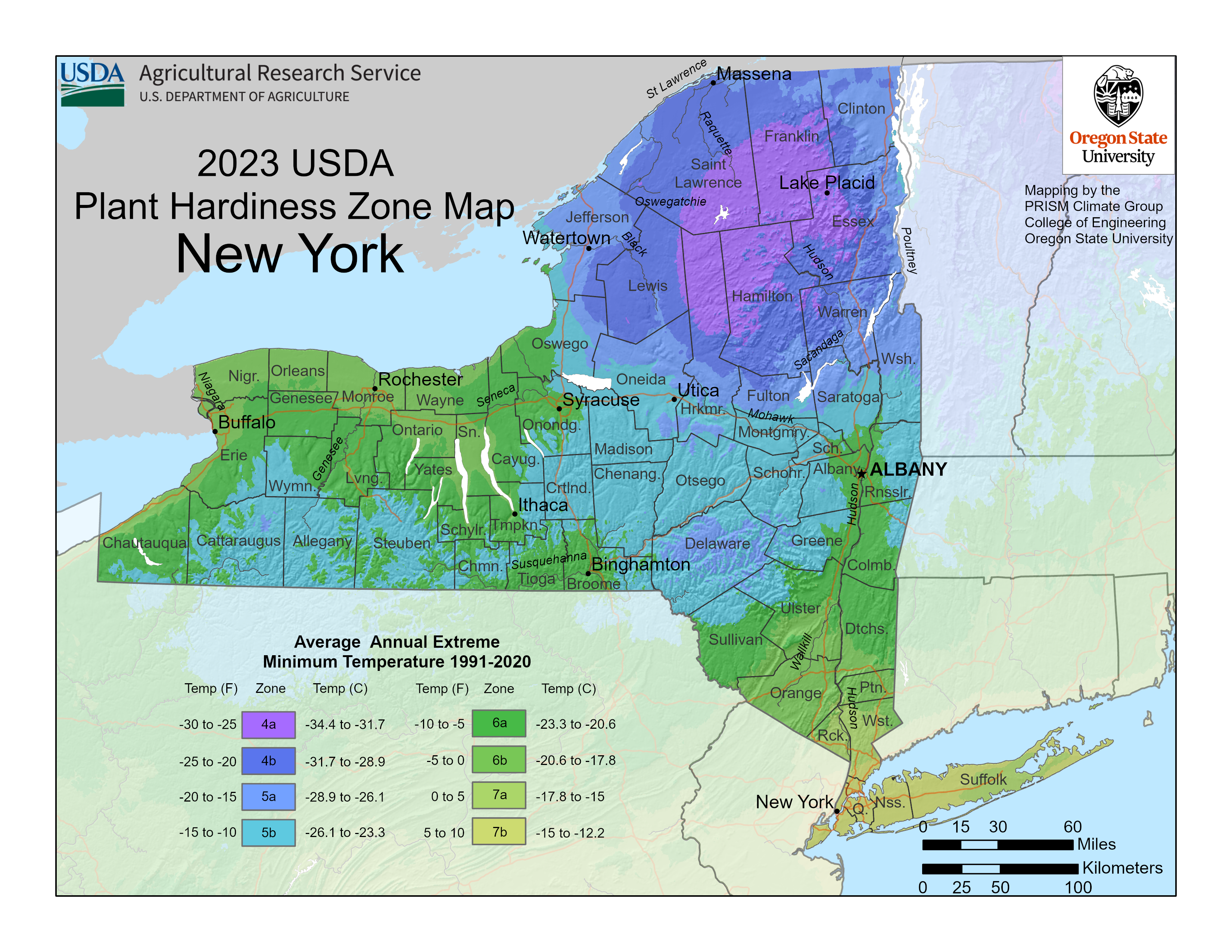
Nassau County has a climate similar to other coastal areas of the Northeastern United States; it has warm, humid summers and cool, wet winters. The county's climate is classified as humid subtropical (Cfa) according to the Köppen climate classification. According to the Trewartha climate classification the climate is oceanic (Do) since six to seven months average above 50″F (10″C). The Atlantic Ocean helps bring afternoon sea breezes that temper the heat in the warmer months and limit the frequency and severity of thunderstorms. Nassau County has a moderately sunny climate, averaging between 2,400 and 2,800 hours of sunshine annually.[41] The hardiness zone is 7b.[42]
In July 2017, the approval was granted by state legislators to the plan proposed by New York GovernorAndrew Cuomo to add a third railroad track to the Long Island Rail Road corridor between the communities of Floral Park and Hicksville in Nassau County. The nearly US$2 billion transportation infrastructure enhancement project was expected to accommodate anticipated growth in rail ridership and facilitate commutes between New York City and Nassau and Suffolk counties on Long Island.[45]
Nassau County also has a public bus network known as NICE (Nassau Inter-County Express, formerly MTA Long Island Bus) that operates routes throughout the county into Queens and Suffolk counties. 24 hour service is provided on the n4, n6, and most recently the n40/41 lines.
U.S. Decennial Census[47]
1790–1960[48] 1900–1990[49]
1990–2000[50] 2010–2020[1]
At the 2019 American Community Survey, the population of Nassau County stood at 1,356,924, an increase of 17,392 since the 2010 census.[51] At the 2010 U.S. census, there were 1,339,532 people, 448,528 households, and 340,523 families residing in the county. The population of Nassau County was estimated by the U.S. Census Bureau to have increased by 2.2% to 1,369,514 in 2017, representing 6.9% of the census-estimated State of New York population of 19,849,399[52] and 17.4% of the census-estimated Long Island population of 7,869,820.[53][54][55][56] At the 2000 United States census, there were 1,334,544 people, 447,387 households, and 347,172 families residing in the county.
In 2010, there were 340,523 family households. 33.5% had children under the age of 18 living with them. 60.0% were married couples living together. 11.7% had a female householder with no husband present. 24.1% were non-families. 20.1% of all households were made up of individuals. 15.1% had someone living alone who was 65 years of age or older. The average household size was 2.94. The average family size was 3.38.[57]
In 2010, the population was 23.3% under the age of 18. 18.7% were 62 years of age or older. The median age was 41.1 years. For every 100 females, there were 93.7 males. For every 100 females age 18 and over, there were 90.4 males.[57] In 2019, there were 474,165 housing units and 446,977 family households.[58] From 2015 to 2019, there was an average of 2.99 persons per household, and 21.4% of the population was under 18 years of age.
At the 2019 American Community Survey, Nassau had a median household income of $116,100. The per capita income was $51,422. About 5.6% of the population lived at or below the poverty line.[58] The median income for a household in the county in 2010 was $72,030. and the median income for a family was $81,246. These figures had risen to $87,658 and $101,661 respectively according to a 2007 estimate.[59] Males had a median income of $52,340 versus $37,446 for females. The per capita income for the county was $32,151. About 3.50% of families and 5.20% of the population were below the poverty line, including 5.80% of those under age 18 and 5.60% of those age 65 or over.
The population density in 2010 was 4,700 people per square mile (1,800 people/km2). In 2000, the population density was 4,655 inhabitants per square mile (1,797/km2). In the 2010 census, there were 468,346 housing units at an average density of 1,598 per square mile (617/km2).
†American Indian, Native Alaskan, Native Hawaiian, and Pacific Islander make up just 0.5% of the population of Long Island, and have been included with "Other".
H Mart in Jericho – one of the busiest H Mart stores on Long Island and one of the busiest Asian-grocery stores outside Asia
In 2010, the racial makeup of the county was 73.0% White (65.5% non-Hispanic white), 10.1% African American, 0.2% Native American, 7.6% Asian (3.0% Indian, 1.8% Chinese, 1.0% Korean, 0.7% Filipino, 0.1% Japanese, 0.1% Vietnamese, 0.9% Other Asian), 0.03% Pacific Islander, 5.6% from other races, and 2.4% from two or more races. Hispanics or Latinos of any race were 15.6% of the population.[57] In 2019, Nassau County's racial and ethnic makeup was 58.2% non-Hispanic white, 11.3% Black or African American, 0.2% American Indian or Alaska Native, 10.3% Asian, 0.7% some other race, and 1.9% two or more races. The Hispanic and Latin American population increased to 17.5% of the population.[61]
Nassau County, New York – Racial and ethnic composition Note: the US Census treats Hispanic/Latino as an ethnic category. This table excludes Latinos from the racial categories and assigns them to a separate category. Hispanics/Latinos may be of any race.
In 2011, there were about 230,000 Jewish people in Nassau County,[71] representing 17.2% of the population, (as compared to 2% of the total U.S. population). Italian Americans also made up a large portion of Nassau's population. The five most reported ancestries were Italian (23%), Irish (14%), German (7%), Indian (5%), and Polish (4%). The county's population was highest at the 1970 U.S. census. More recently, a Little India community has emerged in Hicksville, Nassau County,[72] spreading eastward from the more established Little India enclaves in Queens. Rapidly growing Chinatowns have developed in Brooklyn and Queens,[73][74][75] as did earlier European immigrants, such as the Irish and Italians.
County police services are provided by the Nassau County Police Department. The cities of Glen Cove and Long Beach, as well as a number of villages, are not members of the county police district and maintain their own police forces. The following village police departments exist in Nassau County: Brookville (Brookville P.D. provides police protection for Brookville, Matinecock, Mill Neck and Cove Neck), Centre Island, Floral Park, Freeport, Garden City, Great Neck Estates, Hempstead, Kensington, Kings Point, Lake Success, Lynbrook, Malverne, Muttontown-Upper Brookville, Old Brookville, Old Westbury, Oyster Bay Cove, Rockville Centre and Sands Point.
The Port Washington Police District is not a village department but is authorized by a special district, the only such district in the State of New York. These smaller forces make use of such specialized county police services as the police academy and the aviation unit. All homicides in the county are investigated by the county police, regardless of whether or not they occur within the police district.
In June 2011, the Muttontown Police Department commenced operations. The Old Brookville Police had formerly provided police services to the Village of Muttontown.
On June 1, 2022, the Old Brookville Police Department reverted to serving only the Village of Old Brookville and moved its headquarters to the grounds of the Old Brookville village hall. The Village of Brookville formed a new police department, established headquarters on the grounds of the Brookville Nature Park and assumed policing duties for the villages of Brookville, Matinecock, Mill Neck and Cove Neck, that were formerly served by the Old Brookville Police Department. The Village of Upper Brookville joined the Muttontown Police Department which was subsequently renamed the Muttontown-Upper Brookville (MUB) Police Department. The former Old Brookville Police headquarters is now the Upper Brookville village hall and also a substation for the Muttontown-Upper Brookville Police Department.
In 2006, village leaders in the county seat of Mineola expressed dissatisfaction with the level of police coverage provided by the county force and actively explored seceding from the police district and having the village form its own police force. A referendum in December 2006 decisively defeated the proposal.[85]
The Nassau County Police Department posts the mug shots of DWI offenders as press releases on their website. This practice has come under the scrutiny of residents, media, and those pictured in these press releases. This practice has been criticized as being able to cost potential employees, students, or public figures their positions.[86]
The Nassau County Auxiliary Police are a unit of the Nassau County Police Department. These volunteer police officers are assigned to 1 of 38 local community units and perform routine patrols of the neighborhood. They provide traffic control for local parades, races and other community events. Auxiliary Police officers are empowered to make arrests for crimes that occur in their presence.
Nassau County Auxiliary Police are required to complete a 42-week training course at the Nassau County Police Academy. Qualified officers are offered Emergency Medical Technician (EMT) training. Auxiliary Police officers are certified and registered by the New York Division of Criminal Justice Services as full-time "peace officers". The City of Long Beach has an independent auxiliary police force which is part of its municipal police force. These officers are represented by the Auxiliary Police Benevolent Association of Long Island.
Nassau County is currently protected and served by 71 independent volunteer or combination paid/volunteer fire departments, organized into 9 battalions. The Nassau County Fire Commission also provides logistical support to all 71 departments.[87]
1st Battalion
Department Number
Department Name
100
Bellerose Village
110
Bellerose Terrace
120
Floral Park
130
Floral Park Centre
140
Garden City
150
Garden City Park
160
Mineola
170
New Hyde Park
180
South Floral Park
190
Stewart Manor
2nd Battalion
Department Number
Department Name
200
Baldwin
210
Freeport
220
Village of Island Park
230
Long Beach
240
Oceanside
250
Point Lookout-Lido
3rd Battalion
Department Number
Department Name
300
Hewlett
310
Inwood
320
Lawrence Cedarhurst
330
Meadowmere Park
340
Valley Stream
350
Woodmere
4th Battalion
Department Number
Department Name
400
East Rockaway
410
Lakeview
420
Lynbrook
430
Malverne
440
Rockville Centre
Roslyn Highlands Fire Department in Roslyn Heights in 2012.
This section needs to be updated. The reason given is: August 2024 mask ban. Please help update this article to reflect recent events or newly available information.(August 2024)
The head of the county's governmental structure is the county executive, a post created in Nassau County in 1938. The current county executive is Bruce Blakeman, a Republican who was elected in 2021. The chief deputy county executive is Republican Arthur Walsh. The district attorney is Republican Anne T. Donnelly, who was elected in 2021, replacing Acting District Attorney Joyce Smith. Smith succeeded Madeline Singas after she was nominated and confirmed as an associate judge on the New York Court of Appeals in June 2021.
The county comptroller is Elaine Phillips, a Republican who formerly served in the New York State Senate. The county clerk is Republican Maureen O'Connell. Former elected offices chairman of the County Board of Assessors, county treasurer, and county sheriff were made appointed and serve at the pleasure of the county executive (county assessor in 2008 via referendum, changing it from a six-year term to appointed).[88]
The chief deputy county executive[89] is the highest appointed official in the Nassau County government, serving second-in-command under the auspice of the county executive. The Chief Deputy is responsible for managing the activities of all departments of the Nassau County government, which provides services to its 1.36 million residents. The chief deputy also officially serves as the acting county executive in the absence of, or disability of the County Executive. The current chief deputy county executive is Arthur T. Walsh, who was appointed by Executive Bruce Blakeman in 2022.
The comptroller of Nassau County is the chief fiscal officer and chief auditing officer of the County who presides over the Nassau County Comptroller's Office. The comptroller is elected countywide to a four-year term and has no term limit.
Nassau County Comptrollers (Nassau County Comptroller's Office)
For most of the twentieth century, residents of Nassau County and neighboring Suffolk County primarily supported the Republican Party in national elections. In presidential elections during the first half of the century, the Republican candidate often received more than twice as many votes as the Democratic candidate. Between the county's incorporation in 1899 and the 1980s, Democrats only won Nassau County in the elections of 1912 (where Theodore Roosevelt's Progressive Party split the Republican vote) and 1964 (where Lyndon B. Johnson won in a landslide).
The county began trending Democratic in the 1990s, like many of New York City's suburbs. From 1992 to 2020, it voted for a Democrat in every presidential election. Bill Clinton carried the county in 1992 and 1996, as did Al Gore in 2000, the latter two times by margins of nearly 20 points. John Kerry's margin in Nassau County was considerably slimmer (5.6 points) in 2004, as he won the towns of Hempstead and North Hempstead but lost the town of Oyster Bay. The county went solidly for Barack Obama in 2008 and 2012, both times by around 8 points. Hillary Clinton did marginally worse in 2016, winning by 6 points. Joe Biden in 2020 fared better than Obama to win the county by 9.5 percentage points, but still not as well as Bill Clinton and Gore.
The streak Democratic candidates carrying the county ended in 2024, as Donald Trump carried the county by over four percentage points, the first time Nassau was won by a Republican presidential candidate since 1988.[91]
Democratic strength is chiefly concentrated in both the wealthier and lower income sections of the county. Liberal voters dominate many of the wealthy communities of the North Shore, particularly in the Town of North Hempstead where affluent villages such as Sands Point, Old Westbury, Roslyn, Kensington, Thomaston, Great Neck Plaza, and Great Neck Estates as well as the neighboring City of Glen Cove vote consistently Democratic. Democratic strongholds also include several low income municipalities in the central portion of the county, such as the Village of Hempstead, Roosevelt, Uniondale and New Cassel, as well as in a few waterfront communities on the South Shore, such as the City of Long Beach and the Village of Freeport.
Republican voters are primarily concentrated in the middle to upper middle class southeastern portion of the county, which developed during the "post-war boom era". Heavily Republican communities such as Massapequa, Massapequa Park, Seaford, Wantagh, Levittown, Bethpage, and Farmingdale are the political base of many county GOP officials such as former Congressman Peter T. King and former County Executive Edward P. Mangano. In the western portion of the county, wealthy Garden City is solidly Republican, as is the middle-class community of Floral Park. Additionally, some of the more rustic areas of the North Shore, particularly in the Town of Oyster Bay usually vote for the GOP.
Areas of the county containing large numbers of swing voters include East Meadow, Oceanside, and Rockville Centre on the South Shore and Mineola on the North Shore. Several areas have changed in partisan affiliation. Formerly Democratic strongholds such as the Five Towns and parts of Great Neck have trended to the GOP while previously Republican areas such as Elmont, Valley Stream and Baldwin have become Democratic bastions.
Education features strongly in Nassau County's culture.[citation needed]
Nassau County has 58 public school districts,[92] which like post office districts use the same names as a city, hamlet, or village within them, but each sets the boundaries independently.[93] School district and community are not the same, and residences often have postal addresses that differ from the hamlet and/or school district in which they are located. Several of Nassau County's school districts are among the highest ranked public school systems in the country,[citation needed] including the Jericho Union Free School District, Great Neck Public Schools, and the Syosset Central School District.
Nassau County is home to the New York Islanders of the National Hockey League, who played at the Nassau Veterans Memorial Coliseum in Uniondale from their inception in 1972. However, the Islanders announced in 2012 that starting in the fall of 2015, the team would be moving to Brooklyn and would play at the Barclays Center. Due to issues with Barclays Center being unable to adequately support ice hockey and declining attendance, the Islanders announced that for the 2018–19 season they would split their home games between Barclays Center and the newly renovated Nassau Coliseum. In December 2017, the Islanders won a bid to build a new 18,000-seat arena near Belmont Park in Elmont, returning them to Nassau County; UBS Arena opened in 2021.
The Brooklyn Nets of the National Basketball Association, then known as the New York Nets, formerly played their home games in Nassau County at the now-demolished Island Garden arena in West Hempstead from 1969 to 1972 and then at the Coliseum from 1972 to 1977, before the franchise moved to New Jersey—its original home for several years before coming to Long Island in the late 1960s – and eventually, to Brooklyn.
The first case of COVID-19 was reported in March 2020.[97] As of January 12, 2021, there have been 104,078 cases, 3,044 deaths, 2,102,900 tests conducted, and a 4.9% positivity rate.[98] According to The New York Times' COVID-19 tracker, Nassau County's average daily case count is 1,567 (116 per capita), with 1 in 13 testing positive (the third-worst of any county in the state) and 1 in 545 dying.[99]
In August 2024, Nassau County passed into law a ban on wearing face masks in public, making it a misdemeanor subject to a $1,000 fine and up to one year in prison to wear a facial covering in public, a move that was criticized by the New York Civil Liberties Union as a "dangerous misuse of the law to score political points."[100] The law does not apply to facial coverings "worn to protect the health or safety of the wearer," but does appear to ban wearing a mask in order to protect the health or safety of others, including persons with compromised immune systems.[100]
^Nassau County Atlas, 6th Large Scale Edition, Hagstrom Map Company, Inc., 1999
^"Find a County". National Association of Counties. Archived from the original on May 31, 2011. Retrieved June 7, 2011.
^Toy, Vivian S. (March 30, 2003). "For Sale: Nassau's County Seat". The New York Times. Archived from the original on April 25, 2016. Retrieved February 11, 2017. The county's properties all have mailing addresses in Mineola, the official county seat, but are actually within Garden City's boundaries.
^"Early Five Borough's History". Hope Farm Press. Archived from the original on October 21, 2010. Retrieved December 30, 2007. When Queens County was created the courts were transferred from Hempstead to Jamaica Village and a County Court was erected. When the building became too small for its purposes and the stone meeting house had been erected, the courts were held for some years in that edifice. Later a new courthouse was erected and used until the seat of justice was removed to North Hempstead.
^*"Historical Essay: A Thumbnail View". Official History Page of the Queens Borough President's Office. Archived from the original on December 18, 2007. Retrieved December 29, 2007. From the final withdrawal of the British in November, 1783, until the 1830s, Queens continued as an essentially Long Island area of farms and villages. The location of the county government in Mineola (in present-day Nassau County) underscores the island orientation of that era. Population grew hardly at all, increasing only from 5,791 in 1800 to 7,806 in 1830, suggesting that many younger sons moved away, seeking fortunes where land was not yet so fully taken up for farming.
Jon A. Peterson and Vincent Seyfried, ed. (1983). A Research Guide to the History of the Borough of Queens and Its Neighborhood.
Peterson, Jon A., ed. (1987). A Research Guide to the History of the Borough of Queens, New York City. New York: Queens College, City University of New York.
"New York State History". Genealogy Inc. 1999. Archived from the original on January 8, 2008. Retrieved December 28, 2007. Under the Reorganization Act of March 7, 1788, New York was divided into 120 towns (not townships), many of which were already in existence.
"State of New York; Local Government Handbook; 5th Edition"(PDF). January 2000. pp. Ch 4, p 13, Ch 5 p 2. Archived from the original(PDF) on February 15, 2010. The 1777 New York State Constitution, Article XXXVI, confirmed land grants and municipal charters granted by the English Crown prior to October 14, 1775. Chapter 64 of the Laws of 1788 organized the state into towns and cities...The basic composition of the counties was set in 1788 when the State Legislature divided all of the counties then existing into towns. Towns, of course, were of earlier origin, but in that year they acquired a new legal status as components of the counties.
"History Mysteries: Shelter Island Ferry/Mineola Building". Archived from the original on July 6, 2008. Retrieved April 1, 2008. The building shown below "is one of the most important buildings in the history of Mineola," wrote Jack Hehman, president of the Mineola Historical Society. Built in 1787 and known as the "old brig," it was the first Queens County courthouse and later a home for the mentally ill. The building was at Jericho Turnpike and Herricks Road until 1910, when it burned to the ground.
"The Mineola Asylum; Witnesses who testified that it is and has been a model institution". New York Times. August 29, 1882. Archived from the original on July 25, 2018. Retrieved April 1, 2008. The investigation of the charges made against the Superintendent and keepers of the Mineola Asylum for the Insane, which was begun last Tuesday, was continued yesterday by the standing Committee on Insane Asylums of the Queens County Board of Supervisors-- Messrs. Whitney, Brinckerhoff, and Powell. The committee were shown through the asylum, which is the old building of the Queens County Court-house over 100 years old
John L. Kay & Chester M. Smith, Jr. (1982). New York Postal History: The Post Offices & First Postmasters from 1775 to 1980. American Philatelic Society. There was only one post office established in present Nassau County when the Long Island post road to Sag Harbor was established September 25, 1794. It appears that the mail from New York went to Jamaica. This was the only post office in the present day Boroughs of Queens or Brooklyn before 1803. From Jamaica the mail went east along the Jericho Turnpike/Middle Country Road route and ended at Sag Harbor. The only post office on this route between Jamaica and Suffolk County was QUEENS established the same date as the others on this route 9/25/1794. This post office was officially Queens, but I have seen the area called "Queens Court House" and was located approximately in the Mineola-Westbury area. The courthouse was used until the 1870s when the county court was moved to Long Island City. Later it served as the Queens County Insane Asylum and still later as an early courthouse for the new Nassau County, during construction of the present "old" Nassau County Courthouse in Mineola. It was demolished shortly after 1900 ... after about 120 years of service of one type or the other.
"1873 map of North Hempstead". Archived from the original on June 10, 2007. Retrieved December 31, 2007. bottom right by spur road off Jericho Tpk – location is now known as Garden City Park. Clowesville was the name of the nearest station on the LIRR, approximately at the location of the present Merillon Avenue station. The courthouse was north of the station.
^The former county courthouse was located northeast of the intersection of Jericho Turnpike (NY Route 25) and the aptly named County Courthouse Road in an unincorporated area of the Town of North Hempstead, variously referred to in the present day as Garden City Park or New Hyde Park. The site is now a shopping center anchored by a supermarket and is located in the New Hyde Park 11040 ZIP Code. A stone marker located on the north side of Jericho Turnpike (NY Route 25), between Marcus Avenue and Herricks Road, identifies the site.[22]
^ abRhoda Amon. "Mineola: First Farmers, Then Lawyers". Newsday. Archived from the original on October 15, 2008. Retrieved November 11, 2012. That was the year when the "Old Brig" courthouse was vacated after 90 years of housing lawbreakers. The county court moved from Mineola to Long Island City.
^*"Queen's County Court House"(PDF). New York Times. February 14, 1870. Archived(PDF) from the original on January 30, 2022. Retrieved November 11, 2012.
"Long Island"(PDF). New York Times. December 5, 1870. Archived(PDF) from the original on May 1, 2020. Retrieved November 11, 2012.
^*"A Queens Timeline". The Queens Tribune. Archived from the original on November 9, 2007. Retrieved December 23, 2007. 1874 – Queens County Courthouse and seat of county government moved from Mineola (in present-day Nassau County) to Long Island City.
Salisbury is so named because it sits on a broad, flat section of the larger Hempstead Plains that reminded late 19th Century Long Islanders of the Salisbury Plain in England, where Stonehenge is located.[2] This name was made the CDP's official name for the 1990 census, replacing the older name of South Westbury (which referenced its geographic location immediately south of Westbury).[3]
According to the United States Census Bureau, the CDP has a total area of 1.7 square miles (4.5 km2), of which 1.7 square miles (4.5 km2) is land and 0.57% is water.[4]
At the 2000 census,[6] there were 12,341 people, 4,015 households and 3,340 families residing in the CDP. The population density was 7,164.1 inhabitants per square mile (2,766.1/km2). There were 4,052 housing units at an average density of 2,352.3 per square mile (908.2/km2). The racial makeup of the CDP was 89.94% White, 1.03% African American, 0.14% Native American, 5.97% Asian, 0.01% Pacific Islander, 1.60% from other races, and 1.31% from two or more races. Hispanic or Latino people of any race were 8.56% of the population.
There were 4,015 households, of which 37.2% had children under the age of 18 living with them, 69.9% were married couples living together, 10.4% had a female householder with no husband present, and 16.8% were non-families. 13.9% of all households were made up of individuals, and 8.3% had someone living alone who was 65 years of age or older. The average household size was 3.06 and the average family size was 3.35.
Age distribution was with 24.4% under the age of 18, 7.1% from 18 to 24, 28.2% from 25 to 44, 24.7% from 45 to 64, and 15.6% who were 65 years of age or older. The median age was 39 years. For every 100 females, there were 93.0 males. For every 100 females age 18 and over, there were 89.5 males.
The median household income was $73,641, and the median family income was $81,110. Males had a median income of $50,503 versus $37,002 for females. The per capita income for the CDP was $27,579. About 1.9% of families and 3.7% of the population were below the poverty line, including 3.5% of those under age 18 and 4.3% of those age 65 or over.
Salisbury is located primarily located within the boundaries of (and is thus served by) the East Meadow Union Free School District, although a small portion zoned for commercial use is within the Uniondale Union Free School District.[1] As such, all children who reside within Salisbury and attend public schools go to East Meadow's schools.[1]
This article is about the European aristocratic dynasty. For the former state ruled by this dynasty, the Countship and later Duchy of Nassau, see Nassau (state). For the armorial/coats of arms, see Armorial of the House of Nassau. For other uses, see Nassau (disambiguation).
The House of Nassau is a European aristocratic dynasty. The name originated with a lordship associated with Nassau Castle, which is located in what is now Nassau in Rhineland-Palatinate, Germany. With the fall of the Hohenstaufen dynasty in the first half of the 13th century, royal power within Franconia evaporated and the former stem duchy fragmented into separate independent states. Nassau emerged as one of those independent states as part of the Holy Roman Empire. The lords of Nassau were originally titled "Counts of Nassau", subject only to the Emperor, and then elevated to princely rank as "Princely Counts". Early on, the family divided into two main branches – the elder (Walramian) branch, which gave rise to the German king Adolf, and the younger (Ottonian) branch, which gave rise to the Princes of Orange and the monarchs of the Netherlands.
At the end of the Holy Roman Empire and the Napoleonic Wars, the Walramian branch had inherited or acquired all the Nassau ancestral lands and proclaimed themselves, with the permission of the Congress of Vienna, the "Dukes of Nassau", forming the independent state of Nassau (with its capital at Wiesbaden). This territory now mainly lies in the German Federal State of Hesse, and partially in the neighbouring State of Rhineland-Palatinate. The Duchy was annexed by Prussia in 1866 after the Austrian-Prussian War as an ally of Austria. It was subsequently incorporated into the newly created Prussian Province of Hesse-Nassau.
Today, the term Nassau is used in Germany as a name for a geographical, historical and cultural region, but no longer has any political meaning. All Dutch and Luxembourgish monarchs since 1815 have been senior members of the House of Nassau. However, in 1890 in the Netherlands and in 1912 in Luxembourg, the male lines of heirs to the two thrones became extinct, so that since then, they have descended in the female line from the House of Nassau.
According to German tradition, the family name is passed on only in the male line of succession. The House would therefore, from this German perspective, have been extinct since 1985.[1][2] However, both Dutch and Luxembourgish monarchial traditions, constitutional rules and legislation in that matter differ from the German tradition, and thus neither country considers the House extinct. The Grand Duke of Luxembourg uses "Duke of Nassau" as his secondary title and a title of pretense to the dignity of Chief of the House of Nassau (being the most senior member of the eldest branch of the House), but not to lay any territorial claims to the former Duchy of Nassau (which is now part of the Federal Republic of Germany).
The area that came to be the county of Nassau was part of the Duchy of Franconia. When Franconia fragmented in the early 13th century with the fall of the Hohenstaufen dynasty, Nassau emerged as an independent state as part of the Holy Roman Empire.
Count Dudo-Henry of Laurenburg (c. 1060 – c. 1123) (German: Dudo von Laurenburg; Latin: Tuto de Lurinburg) is considered the founder of the House of Nassau.[3][4] Dudo was a son of Rupert (German: Ruprecht), the Archbishop of Mainz's Vogt in Siegerland.[5] Dudo was himself lord or Vogt of Lipporn and Miehlen and owned large parts of the lands of Lipporn/Laurenburg. There are more persons known who, as owners of the lands of Lipporn/Laurenburg (and thus the predecessors of Dudo), probably also were his ancestors. The first is a certain Drutwin mentioned in 881 as a landowner in Prüm, and who is the oldest known possible ancestor of the House of Nassau.[3]
Laurenburg Castle
Dudo is mentioned as Tuto de Lurinburg between 1093 and 1117. Dudo built the castle of Laurenburg on the Lahn a few kilometers upriver from Nassau around 1090 as the seat of his lordship.[6] He is first mentioned in a document in the purported founding-charter of Maria Laach Abbey in 1093 (although many historians consider the document to be fabricated). In 1159, Nassau Castle became the ruling seat, and the house is now named after this castle. In a charter dated 1134 (after his death) he is mentioned as Count of Laurenburg.[3]
In 1117, Dudo donated land to Schaffhausen Abbey for construction of a monastery in Lipporn. Around 1117, Dudo, Count of Laurenburg founded at Lipporn a Benedictine priory dedicated and named for Saint Florin of Koblenz, and dependent on the Benedictine All Saints Abbey in Schaffhausen. About 1126, his son, Rupert I, Count of Laurenburg, the Vogt of Lipporn, established it as a separate and independent abbey.[7] The Romanesque buildings were constructed between 1126 and 1145, presumably with a three-nave basilica. The abbey included both a monastery for monks and a small, separate one for nuns.[8]
In 1122, Dudo received the castle of Idstein in the Taunus as a fief under the Archbishopric of Mainz. This was part of the inheritance of Count Udalrich of Idstein-Eppstein. He also received the Vogtship of the richly endowed Benedictine Bleidenstadt Abbey (in present-day Taunusstein).[9]
The Counts of Laurenburg and Nassau expanded their authority under the brothers Robert (Ruprecht) I (1123–1154) and Arnold I of Laurenburg (1123–1148). Robert was the first person to call himself Count of Nassau, but the title was not confirmed until 1159, five years after Robert's death. Robert's son Walram I (1154–1198) was the first person to be legally titled Count of Nassau.
The chronology of the Counts of Laurenburg is not certain and the link between Robert I and Walram I is especially controversial. Also, some sources consider Gerhard, listed as co-Count of Laurenburg in 1148, to be the son of Robert I's brother, Arnold I.[10] However, Erich Brandenburg in his Die Nachkommen Karls des Großen states that it is most likely that Gerhard was Robert I's son, because Gerard was the name of Beatrix of Limburg's maternal grandfather.[11]
As noted above, the county of Nassau was part of the stem Duchy of Franconia. It branched off northeast from the Rhine River and followed the course of the Lahn and Sieg rivers. Northeast and southeast of it was the lands of the House of Hesse. With the fall of the Hohenstaufen in the first half of the 13th century royal power within Franconia evaporated and the former stem duchy fragmented into separate independent states. Nassau emerged as one of those independent states as part of the Holy Roman Empire.
Nassau, originally a county, but part of the duchy of Franconia, developed on the lower Lahn river in what is known today as Rhineland-Palatinate. The town of Nassau was founded in 915.[12] As noted above, Dudo of Laurenburg held Nassau as a fiefdom as granted by the Bishopric of Worms. His son, Rupert, built the Nassau Castle there around 1125, declaring himself "Count of Nassau". This title was not officially acknowledged by the Bishop of Worms until 1159 under the rule of Rupert's son, Walram. By 1159, the County of Nassau effectively claimed rights of taxation, toll collection, and justice, at which point it can be considered to become a state.[12]
The Nassauers held the territory between the Taunus and the Westerwald at the lower and middle Lahn. By 1128, they acquired the bailiwick of the Bishopric of Worms, which had numerous rights in the area, and thus created a link between their heritage at the lower Lahn and their possessions near Siegen. In the middle of the 12th century, this relationship was strengthened by the acquisition of parts of the Hesse-Thüringen feudal kingdom, namely the Herborner Mark, the Kalenberger Zent and the Court of Heimau (Löhnberg). Closely linked to this was the "Lordship of Westerwald", also in Nassau's possession at the time. At the end of the 12th century, the House acquired the ReichshofWiesbaden, an important base in the southwest.
In 1255, after the Counts of Nassau acquired the estates of Weilburg, the sons of Count Henry II divided Nassau for the first time. Walram II received the county of Nassau-Weilburg. From 1328 on, his younger brother, Otto I, held the estates north of the Lahn river, namely the County of Nassau-Siegen and Nassau-Dillenburg. The boundary line was essentially the Lahn, with Otto receiving the northern part of the county with the cities of Siegen, Dillenburg, Herborn and Haiger and Walram retaining the section south of the river, including the cities of Weilburg and Idstein.
Nassau (light yellow) within the Holy Roman Empire during the rule of the Staufers
Course of the Lahn River through Nassau and Hesse.County of Nassau (grey) within the Holy Roman Empire in 1400 A.D.
In 1255, Henry II's sons, Walram II and Otto I, split the Nassau possessions. The descendants of Walram became known as the Walram Line, which became important in the Countship of Nassau and Luxembourg. The descendants of Otto became known as the Ottonian Line, which would inherit parts of Nassau, France and the Netherlands. Both lines would often themselves be divided over the next few centuries. In 1783, the heads of various branches of the House of Nassau sealed the Nassau Family Pact (Erbverein) to regulate future succession in their states, and to establish a dynastic hierarchy whereby the Prince of Orange-Nassau-Dietz was recognised as President of the House of Nassau.[13]
Crowned Lion arms and crest of the Walram line now seen in the coat of arms of Luxembourg: "d'azur, semé de billettes d'or, au lion couronné du second, armé, lampassé de gueules.'"[14]
The Walramian Line concentrated their efforts primarily on their German lands. The exception was Adolf, King of the Romans (c. 1255 – 2 July 1298) who was the count of Nassau from about 1276 and the elected king of Germany from 1292 until his deposition by the prince-electors in 1298. He was never crowned by the pope, which would have secured him the imperial title. He was the first physically and mentally healthy ruler of the Holy Roman Empire ever to be deposed without a papal excommunication. Adolf died shortly afterwards in the Battle of Göllheim fighting against his successor Albert of Habsburg. He was the second in the succession of so-called count-kings of several rivalling comital houses striving after the Roman-German royal dignity after the expiration the Hohenstaufen. The Nassaus, however, were not on the imperial throne long enough to establish themselves in larger landholdings to increase their hereditary power such as the Luxemburgers did in Bohemia or the Habsburgs did in Austria.
After Gerlach's death, the possessions of the Walram line were divided into Nassau-Weilburg and Nassau-Wiesbaden-Idstein.
Count Walram II began the Countship of Nassau in Weilburg (Nassau-Weilburg), which existed to 1816. The Walram line also received the lordship of Merenberg in 1328 and Saarbrücken (by marriage) in 1353. The sovereigns of this house afterwards ruled the Duchy of Nassau from its establishment in 1806 as part of the Confederation of the Rhine (jointly with Nassau-Usingen until 1816). The last reigning Duke, Adolph, became Duke of Nassau in August 1839, following the death of his father William. The Duchy was annexed to Prussia in 1866 after Austria's defeat in the Austro-Prussian War.
From 1815 to 1839, Grand Duchy of Luxembourg was ruled by the kings of the Netherlands as a province of the Netherlands. Following the Treaty of London (1839), the Grand Duchy of Luxembourg became independent but remained in personal union with the Netherlands. Following the death of his sons, the Dutch king William III had no male heirs to succeed him. In the Netherlands, females were allowed to succeed to the throne. Luxembourg, however, followed Salic law which barred females from succession. Thus, upon King William III's death, the crown of the Netherlands passed to his only daughter, Wilhelmina, while that of Luxembourg passed to Adolph in accordance with the Nassau Family Pact. Adolph died in 1905 and was succeeded by his son, William IV.
In 1907 Grand Duke Adolph declared the family non-dynastic/morganatic. Had they not been excluded from the succession, they would have inherited the headship of the house in 1912. Georg Nickolaus would have thus become the reigning Grand Duke of Luxembourg.
In 1907, William IV, obtained passage of a law in Luxembourg confirming the exclusion of the Merenbergs from succession to the grand ducal throne. Georg Nikolaus's protests against the Luxembourg Diet's confirmation of the succession rights of William IV's daughter, Princess Marie-Adélaïde, were expected to be taken up by the Netherlands and by the Great Powers which had guaranteed Luxembourg's neutrality in 1867.[15] Nonetheless, Marie-Adélaïde did succeed her father, to become Luxembourg's first female monarch, in 1912. She, in turn, abdicated in favour of her sister Charlotte, whose descendants have reigned over Luxembourg since then. Georg Nikolaus died in 1948. His son Georg Michael Alexander was the last legitimate descendant of the House of Nassau. He died in 1965
From the documentary mention in 1102 until 1721, Idstein was, with interruptions, residence of the Counts of Nassau-Idstein and other Nassau lines. One of the Counts was, as said above, Adolf of Germany, the Holy Roman Emperor from 1292 to 1298.
The Nassau Counts' holdings were subdivided many times among heirs, with the parts being brought together again whenever a line died out. This yielded an older Nassau-Idstein line from 1480 to 1509, later merging once again with Nassau-Wiesbaden and Nassau-Weilburg and, from 1629 to 1721, a newer Nassau-Idstein line.
In 1721, Idstein passed to Nassau-Ottweiler, and in 1728 to Nassau-Usingen, thereby losing its status as a residence town, although it became the seat of the Nassau Archives and of an Oberamt.
In the 1170s, the Count of Nassau, Walram I, received the area around Wiesbaden as a fiefdom. In 1232, Wiesbaden became a Reichsstadt, an imperial city, of the Holy Roman Empire. Wiesbaden returned to the control of the House of Nassau in 1270 under Count Walram II, Count of Nassau. However, Wiesbaden and the castle at Sonnenberg were again destroyed in 1283 in conflict with Eppstein.
Walram's son and successor Adolf was, as said above, king of Germany from 1292 until 1298. In 1329, under Adolf's son Gerlach I of Nassau-Weilburg the House of Nassau and thereby, Wiesbaden, received the right of coinage from Holy Roman Emperor Louis the Bavarian.
In 1355, the County of Nassau-Weilburg was divided among the sons of Gerlach. The County of Nassau's holdings would be subdivided many times among heirs, with the parts being brought together again whenever a line died out. Wiesbaden became the seat of the County of Nassau-Wiesbaden under Count Adolf I (1307–1370), eldest son of Gerlach. It eventually fell back to Nassau-Weilburg in 1605.
Philipp I ruled both Nassau-Saarbrücken and Nassau-Weilburg and in 1393 inherited through his wife Johanna of Hohenlohe the lordships Kirchheimbolanden and Stauf. He also received half of Nassau-Ottweiler in 1393 and other territories later during his reign. After his death in 1429 the territories around Saarbrücken and along the Lahn were kept united until 1442, when they were again divided among his sons into the lines Nassau-Saarbrücken (west of the Rhine) and Nassau-Weilburg (east of the Rhine), the so-called Younger line of Nassau-Weilburg.
In 1507, Count John Ludwig I significantly enlarged his territory. After his death in 1544 the county was split into three parts, the three lines (Ottweiler, Saarbrücken proper and Kirchheim) were all extinct in 1574 and all of Nassau-Saarbrücken was united with Nassau-Weilburg until 1629. This new division, however, was not executed until the Thirty Years' War was over and in 1651 three counties were established: Nassau-Idstein, Nassau-Weilburg and Nassau-Saarbrücken.
The county of Saarbrücken in the Rheinland in light yellow.
Only eight years later, Nassau-Saarbrücken was again divided into:
In 1735, Nassau-Usingen was divided again into Nassau-Usingen and Nassau-Saarbrücken. In 1797 Nassau-Usingen finally inherited Nassau-Saarbrücken, it was (re-)unified with Nassau-Weilburg and raised to the Duchy of Nassau in 1806. The first Duke of Nassau was Frederick August of Nassau-Usingen who died in 1816. Wilhelm, Prince of Nassau-Weilburg inherits the Duchy of Nassau. But, territories of Nassau Saarbrücken was occupied by France in 1793 and was annexed as Sarre department in 1797. Finally County of Nassau-Saarbrücken was part of Prussia in 1814.
The origin of the county lies in the medieval county of Weilnau that was acquired by the counts of Nassau-Weilburg in 1602. That county was divided in 1629 into the lines of Nassau-Weilburg, Nassau-Idstein and Nassau-Saarbrücken that was divided only 30 years later in 1659. The emerging counties were Nassau-Saarbrücken, Nassau-Ottweiler and Nassau-Usingen. At the beginning of the 18th century, three of the Nassau lines died out and Nassau-Usingen became their successor (1721 Nassau-Idstein, 1723 Nassau-Ottweiler und 1728 Nassau-Saarbrücken). In 1735 Nassau-Usingen was divided again into Nassau-Usingen and Nassau-Saarbrücken. In 1797 Nassau-Usingen inherited Nassau-Saarbrücken. In 1816, Nassau-Usingen merged with Nassau-Weilburg to form the Duchy of Nassau. See "Dukes of Nassau" above.
Following Frederick Augustus' death, the princely title was adopted (in pretense) by his half brother through an unequal marriage, Karl Philip. As head of the House in 1907, Wilhelm IV declared the Count of Merenberg non-dynastic; by extension, this would indicate that (according to Luxembourgish laws regarding the House of Nassau) this branch would assume the Salic headship of the house in 1965, following the death of the last male Count of Merenberg.[16]
Arms and crest of the Ottonian line (since the 13th century) now part of the coat of arms of the Netherlands: "d'azur semé de billettes d'or, au lion du même, armé et lampassé de gueules, brochant sur le tout".[14]
the County of Nassau (green) in 1547Electoral Hesse and the Nassau lands in the earl 19th century showing the multiple divisions based on family lines.
The partition of the county of Nassau between Otto, and his older brother Walram (above), resulted in a permanent division between the 2 branches of the family. The Walramian branch tended to concentrate on their German lands, while the Ottonians, as we will see below, established themselves in the Netherlands and became great magnates, leaders of the Dutch Revolt, the stadtholders of the Dutch Republican government, and eventual kings of the Netherlands. This, however, was not before many divisions and reunitings. The first was between sons of Otto, with the main power base being centered around the caste of Dillenburg:
1255–1290: Otto I, Count of Nassau in Siegen, Dillenburg, Beilstein, and Ginsberg
In 1303, Otto's sons divided the possessions of the Ottonian line. Henry received Nassau-Siegen, John received Nassau-Dillenburg and Emicho I received Nassau-Hadamar. After John's death. Nassau-Dillenburg fell to Henry.
The Ottonian portion of the county of Nassau was divided and sub-divided, as shown in the genealogical charts below, several times, so that each son of the previous count would have a portion. Eventually, these lines would all die out in favor of the main branch of the family, which had established themselves in The Netherlands.
The counts of Nassau in Beilstein were involved mostly in local/regional German affairs in their area of the Rhine.
In 1343, Nassau-Beilstein was split off from Nassau-Dillenburg. After John III's death, Nassau-Beilstein fell back to Nassau-Dillenburg. It was split off again in 1607 (see below) for George, who inherited the rest of Nassau-Dillenburg in 1620.
The importance of the Nassaus grew throughout the 15th and 16th century. Henry III of Nassau-Breda was appointed stadtholder of Holland, Zeeland and Utrecht by Emperor Charles V in the beginning of the 16th century. Henry married Claudia of Chalon-Orange from French Burgundy in 1515. Their son René of Chalon inherited in 1530 the independent and sovereign Principality of Orange from his mother's brother, Philibert of Chalon. As the first Nassau to be the Prince of Orange, René could have used "Orange-Nassau" as his new family name. However, his uncle, in his will, had stipulated that René should continue the use of the name Chalon-Orange. At René's death in 1544, he left all his lands to his cousin William of Nassau-Dillenburg, including the sovereign principality of Orange. This "William I of Orange", in English better known as William the Silent, became the founder of the House of Orange-Nassau and the leader of the Dutch Revolt that lead to the formation of the Dutch Republic as a separate sovereign nation.[17]: 10
Within the government of the Dutch Republic, The Prince of Orange was also not just another noble among equals in the Netherlands. First, he was the traditional leader of the nation in war and in rebellion against Spain. He was uniquely able to transcend the local issues of the cities, towns and provinces. He was also a sovereign ruler in his own right (see Prince of Orange article). This gave him a great deal of prestige, even in a republic. He was the center of a real court like the Stuarts and Bourbons, French speaking, and extravagant to a scale. It was natural for foreign ambassadors and dignitaries to present themselves to him and consult with him as well as to the States General to which they were officially credited. The marriage policy of the princes, allying themselves twice with the Royal Stuarts, also gave them acceptance into the royal caste of rulers.[18]: 76–77, 80
The house of Orange-Nassau was relatively unlucky in establishing a hereditary dynasty in an age that favoured hereditary rule. The Stuarts and the Bourbons came to power at the same time as the Oranges, the Vasas and Oldenburgs were able to establish a hereditary kingship in Sweden and Denmark, and the Hohenzollerns were able to set themselves on a course to the rule of Germany. The House of Orange was no less gifted than those houses, in fact, some might argue more so, as their ranks included some the foremost statesmen and captains of the time. Although the institutions of the United Provinces became more republican and entrenched as time went on, William the Silent had been offered the countship of Holland and Zealand, and only his assassination prevented his accession to those offices. This fact did not go unforgotten by his successors.[17]: 28–31, 64, 71, 93, 139–141
Besides showing the relationships among the family, the tree above then also points out an extraordinary run of bad luck. In the 211 years from the death of William the Silent to the conquest by France, there was only one time that a son directly succeeded his father as Prince of Orange, Stadholder and Captain-General without a minority (William II). When the Oranges were in power, they also tended to settle for the actualities of power, rather than the appearances, which increasingly tended to upset the ruling regents of the towns and cities. On being offered the dukedom of Gelderland by the States of that province, William III let the offer lapse as liable to raise too much opposition in the other provinces.[18]: 75–83
Prins Maurice with his two brothers, their nephew, Frederik V of the Palatine and King of Bohemia, and various members of the House of Nassau on parade. In the first row, from left to right: Prince Maurice, Stadholder of Holland and Captain-General, his nephew Frederik V (1596–1632), Elector Palatine and King of Bohemia, Prince Philip William, then the reigning prince of Orange, and Prince Frederick Henry. in the 2nd row, among others: William Louis, count of Nassau-Dillenburg and Stadholder of Friesland, Ernst Casimir (1573–1632), count of Nassau-Dietz and Louis Gunther, count of Nassau. The painting was entitled 'de Nassausche helden'.
With the death of William III, the legitimate direct male line of William the Silent became extinct and thereby the first House of Orange-Nassau. John William Friso, the senior agnatic descendant of William the Silent's brother and a cognatic descendant of Frederick Henry, grandfather of William III, inherited the princely title and all the possessions in the low countries and Germany, but not the Principality of Orange itself. Orange had been invaded and captured by King Louis XIV in 1672 during the Franco-Dutch War, and again in August 1682, but William did not concede his claim to rule, and recovered the principality via the peace treaties. Louis again invaded and captured the principality in 1702. He enfeoffed François Louis, Prince of Conti, a Bourbon relative of the Chalon dynasty, with the Principality of Orange, so that there were three claimants to the title. The Principality was finally ceded to France under the Treaty of Utrecht that ended the wars with King Louis XIV. Frederick I of Prussia ceded the Principality to France (without surrendering the princely title), though John William Friso of Nassau-Dietz, the other claimant to the principality, did not concur. Only with the treaty of partition in 1732 did John William Friso's successor William IV, Prince of Orange, renounce all his claims to the territory, but again (like Frederick I) he did not renounce his claim to the title. In the same treaty an agreement was made between both claimants, stipulating that both houses be allowed to use the title.[19] John William Friso, who also was the Prince of Nassau-Dietz, founded thereby the second House of Orange-Nassau (the suffix name "Dietz" was dropped of the combined name Orange-Nassau-Dietz).
The Revolutionary and Napoleonic era was a tumultuous episode of the history of both the Ottonian and Walramian branches of the House of Nassau. France's dominance of the international order severely strained the House of Nassau's traditional strategy of international conflict resolution, which was to maintain links with all serious power-brokers through a dynastic network in the hope of playing one off against the other. Despite that both branches of the House of Nassau reinvigorated the dynastic network in the years of liberation, 1812–1814, the post-Napoleonic European order saw both branches set on different historical paths.[20]
After the post-Napoleonic reorganization of Europe, the head of House of Orange-Nassau became "King/Queen of the Netherlands".
1544–1584: William I, also Count of Katzenelnbogen, Vianden, Dietz, Buren and Leerdam and Lord of IJsselstein, Baron of Breda, etc. Stadholder of Holland, Zealand and Utrect, etc.
1584–1618: Philip William, also Count of Nassau-Dillenburg, Count of Vianden, Buren and Leerdam and Lord of IJsselstein, Baron of Breda, etc.
1618–1625: Maurice, also Count of Nassau-Dillenburg, Count of Vianden, Buren and Leerdam and Lord of IJsselstein, Baron of Breda, etc. Stadholder of Holland, Zealand and Utrect, etc., Captain-General of the Armies of the Dutch Republic.
1625–1647: Frederick Henry, also Count of Nassau-Dillenburg, Count of Vianden, Buren and Leerdam and Lord of IJsselstein, Baron of Breda, etc. Stadholder of Holland, Zealand and Utrect, etc., Captain-General of the Armies of the Dutch Republic.
1647–1650: William II, also Count of Nassau-Dillenburg, Count of Vianden, Buren and Leerdam and Lord of IJsselstein, Baron of Breda, etc., Stadholder of Holland, Zealand and Utrect, etc., Captain-General of the Armies of the Dutch Republic.
1650–1702: William III, also Count of Nassau-Dillenburg, Count of Vianden, Buren and Leerdam, Lord of IJsselstein, Baron of Breda, etc., Stadholder of Holland, Zealand and Utrect, etc., Captain-General of the Armies of the Dutch Republic, and (from 1689) King of England, Scotland, and Ireland
In 1702, the Orange-Nassau line ended with King William III. He named his cousin John William Friso of Nassau-Dietz as his heir in The Netherlands and the principality of Orange, passing over the claims of the Hohenzollerns of Brandenburg/Prussia.
1702–1711: John William Friso, also Prince of Nassau-Dietz, Count of Vianden, Buren and Leerdam and Lord of IJsselstein, Baron of Breda, etc. Stadholder of Holland, Zealand and Utrect, etc., Captain-General of the Armies of the Dutch Republic.
1711–1751: William IV, also Prince of Nassau-Dietz, Count of Vianden, Buren and Leerdam and Lord of IJsselstein, Baron of Breda, etc. Stadholder of Holland, Zealand and Utrect, etc., Captain-General of the Armies of the Dutch Republic.
1751–1806: William V, also Prince of Nassau-Dietz, Count of Vianden, Buren and Leerdam and Lord of IJsselstein, Baron of Breda, etc. Stadholder of Holland, Zealand and Utrect, etc., Captain-General of the Armies of the Dutch Republic.
1806–1815: William VI, also Prince of Fulda and Count of Corvey, Weingarten and Dortmund; in 1815 became King William I of the Netherlands
Royal coat of arms of the Netherlands
Kings and Queens of the Netherlands (from the House of Orange-Nassau-Dietz)
Following the laws of the Holy Roman Empire (which was abolished in 1806), the House of Orange-Nassau(-Dietz) has been extinct since the death of Wilhelmina (1962). Dutch laws and the Dutch nation do not consider it extinct.
When William the Silent inherited the lands of the Netherland Nassaus and the Principality of Orange, the German lands in the county of Nassau went to his younger brother, Jan VI, as shown below, and were subdivided amongst his surviving sons in 1606. A good many of these maintained ties with the Dutch Republic and served as stadholders and officers in the Dutch States Army.
The counts of Nassau in Dillenburg were the continuation of the main line of the Ottonian counts of Nassau, although only the 2nd oldest after The Netherlands Nassaus/house of Orange-Nassau. John VI is called the "elder", but this is not in relation to his older brother William the Silent, but in relation to his son, John VII "the Middle" and his grandson, John VIII "the younger". In the male line, the kings of The Netherlands spring from John VI until Queen Wilhelmina abdicated in 1948. John VI played a leading role during the Dutch Revolt: he was the principal author of the Union of Utrecht, which was the constitution of the Dutch Republic. He also served as stadholder of Utrect and Gelderland when they were reconquered from the Spanish. His eldest son, William Louis "Us Heit" (West Frisian for "our father") was Stadholder of Friesland, Groningen, and Drenthe, a General in the Dutch States Army and the chief lieutenant of his cousin Prince Maurice of Nassau, in their innovations in military strategy and organization, victories in the field, and governing of the Dutch Republic.
The counts (later princes in 1650) of Nassau-Dietz continued their service to the Dutch Republic. After the death of William Louis (see Second House of Nassau-Dillenburg) they were usually elected Stadholder of Friesland, Groningen, and Drenthe. They also served as senior Generals in the Dutch States Army.
Princes of the House of Nassau-Dietz from the Stadhouderlijk Hof of Paleis in Leeuwaarden, H.Prince of Nassau, Henry Casimir, Prince of Nassau, George, Prince of Nassau, and Willem Frederick, Prince of Nassau-Dietz
In his will, William III appointed John William Friso as his heir in The Netherlands (his lordships being his property to dispose of by law) as well as his heir to the principality of Orange, the principality being a sovereign state, and so his right to appoint his successor. This was contested by the House of Hohenzollern, kings of Prussia, and not finally settled until the mid 18th century. In any case, the succession was in the title only, as Louis XIV of France had conquered the actual territory.
In 1620, the younger line of Nassau-Hadamar was split off from Nassau-Dillenburg, as shown below. John Louis, the first count, was a diplomat, who tried to protect his county from the ravages of the Thirty Years War. In 1647, for his efforts in bringing about peace between Spain and the Netherlands, King Philip IV of Spain appointed him a knight in the Order of the Golden Fleece. In addition, as a special thanks for his role in establishing the Peace of Westphalia, he was elevated to the rank of prince in 1650 by Emperor Ferdinand III. He did convert to Catholicism, so that Hadamar was Catholic after that.
In 1606, the younger line of Nassau-Siegen was split off from the House of Nassau-Dillenburg for John VII "the Middle". As Dillenburg eventually was inherited by a younger son of John VI (see below), the line of Nassau-Siegen became the elder line of the Ottonian House of Nassau. After John VII of Nassau-Siegen died in 1628, the land was divided:
His eldest son, John VIII "the Younger", had converted to Catholicism and joined the Spanish Army. This caused a rivalry between him and his brother John Maurice below. The result was that Siegen was split. John VIII received the part of the county south of the river Sieg and the original castle in Siegen (which after 1695 was called the "Upper Castle"). John VIII was the founder of the Catholic line of Nassau-Siegen.
Sieg River through Nassau
John Maurice, who remained Protestant, was a soldier. He received the part of the county north of the Sieg. He was the founder of the Protestant line of Nassau-Siegen and he converted the former Franciscan monastery into a new residence, called the "Lower Castle", which was reconstructed after having burnt down at large parts in 1695. John Maurice spent most of his time away from Siegen, since he was governor of Dutch Brazil and later of the Prussian province of Cleves, Mark, and Ravensberg. In 1668, he was appointed first field-marshal of the Dutch States Army, and in 1673, he was charged by the StadtholderWilliam III to command the forces in Friesland and Groningen, and to defend the eastern frontier of the provinces, again against Van Galen. In 1675, his health compelled him to give up active military service, and he spent his last years in his beloved Cleves, where he died in December 1679. Between 1638 and 1674, his brother George Frederick ruled the Protestant part of the country.
In 1734, the Protestant line died out with the death of Frederick William II. Protestant Nassau-Siegen was annexed by Christian of Nassau-Dillenburg and William IV of Nassau-Diez. When William Hyacinth, the last ruler of the Catholic line, died in 1743, Nassau-Siegen had died out in the male line, and the territory fell to Prince William IV of the Orange-Nassau-Dietz line, who thereby reunited all the lands of the Ottonian line of the House of Nassau.
Siegen, Upper CastleGozdzki – de Nassau Palace in Warsaw that belonged to wealthy Karolina Gozdzka (1747–1807) and her husband Charles Henry de Nassau-Siegen (1745–1808).[21]
The ancestral coat of arms of the Ottonian line of the house of Nassau is shown below. Their distant cousins of the Walramian line added a red coronet to distinguish them. There is no documentation on how and why these arms came to be. As a symbol of nobility, the lion was always a popular in western culture going all the way back to Hercules. Using the heraldic insignia of a dominant power was a way, and still is a way, to show loyalty to that power. Not using that insignia is a way to show independence. The Netherlands, as territories bordering on the Holy Roman Empire with its Roman eagle and France with its Fleur-de-lis, had many examples of this. The lion was so heavily used in the Netherlands for various provinces and families (see Leo Belgicus) that it became the national arms of the Dutch Republic, its successor states the Netherlands, Belgium, and Luxembourg. Blue, because of its nearness to purple, which in the northern climes tended to fade (red was the other choice), was also a popular color for those with royal aspirations. The billets could have been anything from blocks of wood to abstractions of the reinforcements holding the shield together. The fact that these were arms were very similar to those of the counts of Burgundy (Franche-Comté) did not seem to cause too much confusion. It also held with one of the basic tenants of heraldry, that arms could not be repeated within a kingdom, but Nassau was considered to be in the Kingdom of Germany, while Franche-Comté was in the kingdom of Burgundy (see also Scrope v Grosvenor).[22][23]
Coats of arms of sovereignty also show the territories that the dynasty claims to rule over. The principle ones are depicted below, i.e.
The Principality of Orange, which gave them their major title and claim to equal status with all the other sovereign rulers of the world, Prince of Orange.
County of Buren, also long the delta of the Rhine, but further inland.
In most of the estates in the more populous provinces of Holland and Zealand, the land itself was secondary to the profit on the commerce that flowed through it.
Anna Margaretha van Nassau (1634–1676)married (1) Diederik Schenk van Nydeggen heer van Blijenbeek, Afferden en Grubbenvorst
married (2) Johan Gerard van Oostrum heer van Moersbergen, Cattenbroek en Zeist, col in Dutch Army, 2 daughters.
(Morganatic?) Emmanuel Ignatius of Nassau-Siegen (1688–1735)
Baron de Renaix (1699), Prince-Regent of Nassau-Siegen, (1727), Fieldmarshal of the Spanish Army, Knight of the Order of Malta (1697), Knight of the Order of the Golden Fleece (1715), Knight of the Order of St. Hubertus (1720)
^Grand Duchess Charlotte abdicated in 1964, but she died in 1985
^Clotilde Countess of Nassau-Merenberg is the last patrilineal descendant of the House of Nassau though she descends from a family considered to be non-dynastic
^ abLa Cour grand-ducale (ed.). "Armoiries". Cour de Grand-Ducale de Luxembourg (in French). Luxembourg City, Luxembourg. Retrieved 24 April 2019.:
Armoiries valables du Grand-Duc Adolphe au Grand-Duc Jean
Grandes armes Parti de trois coupé de trois, qui font seize quartiers, les quatre quartiers du centre formant écu sur le tout, écartelé de Nassau et de Luxembourg :
au I de Sarrebruck qui est d'azur semé de croisettes recroisettées au pied fiché d'argent, au lion du même couronné d'or, brochant, au II de Merenberg qui est de sinople au sautoir d'or cantonné de douze croisettes du même, au III de Weilnau qui est d'or à deux léopards de gueules, lampassés d'azur, au IV de Moers, qui est d'or à la fasce de sable, au V de Katzenelnbogen qui est d'or au léopard lionné de gueules, armé et lampassé d'azur, au VI de Nassau qui est d'azur semé de billettes d'or, au lion même, armé et lampassé de gueules, couronné d'or brochant (formant premier quartier du surtout), au VII de Luxembourg qui est burelé d'argent et d'azur, au lion de gueules, armé, lampassé et couronné d'or, la queue fourchue et passée en sautoir, brochant (deuxième quartier surtout), au VIII de Saarwerden, qui est de sable à l'aigle éployée d'argent, armée d'or, lampassée de gueules, au IX de Dietz qui est de gueules à deux léopards d'or, armés et lampassés d'azur, l'un sur l'autre, au X de Luxembourg (voir VII), formant le quartier III du surtout, au XI de Nassau (voir VI), formant le quartier IV du surtout, au XII de Lahr qui est d'or à la fasce de gueules, au XIII de Vianden qui est de gueules à la fasce d'argent, au XIV de Kirchberg, qui est d'argent à trois pals de sable, au XV de Sayn, qui est de gueules à léopard lionné d'or, armé et lampassé d'azur, la queue fourchue (et passé en sautoir), au XVI de Mahlberg qui est d'or au lion de sable, armé, lampassé et couronné de gueules. L'écu est surmonté de six casques, le premier et le sixième couronnés.
Cimiers :
Une tête et col de lévrier contourné d'or, lampassé de gueules, colleté de sable, bordé et bouclé d'argent. Lambrequins d'or et de sable (Moers). Un vol coupé d'argent et de sable. L. d'argent et de sable (Sarrebruck). Un lion assis d'or, lampassé et couronné de gueules, entre deux proboscides d'azur semées de billettes d'or (Nassau). Lambrequins d'or et d'azur. Un vol de sable (pour Luxembourg). Lambrequins d'argent et d'azur. Un vol de sable chargé d'un disque de gueules à deux léopards d'or. L. d'or et de gueules (Diez). Un chapeau pyramidal d'or, la pointe recourbée. L. d'or et de gueules (Sayn). Support : deux lions couronnés d'or, lampassés de gueules, la tête contournée.
L'écu et les supports posés sur quatre rinceaux entrelacés d'or.
Manteau de pourpre, frangé et lié d'or, doublé d'hermines, sommé de la couronne royale.
Théoriquement, les trois ordres : Lion d'Or de Nassau, Couronne de Chêne et Ordre d'Adolphe de Nassau devraient être appendus en bas de l'écu, mais cela ne fut jamais réalisé.
Moyennes armes L'écartelé de Nassau-Luxembourg (formant surtout dans les grandes armes), sommé d'une couronne royale, supporté par les deux lions, le tout sous le manteau de pourpre couronné de la couronne royale.
Petites Armes
L'écartelé Nassau-Luxembourg sommé de la couronne royale (sans supports ni manteau).
^ abLa Cour grand-ducale (ed.). "Armoiries". Cour de Grand-Ducale de Luxembourg (in French). Luxembourg City, Luxembourg. Retrieved 24 April 2019.:
Armoiries fixées par S.A.R. le Grand-Duc Henri
Petites armoiries Ecartelé, aux I et IV de Luxembourg qui est un burelé d'argent et d'azur, au lion de gueules, la queue fourchue et passée en sautoir, armé, lampassé et couronné d'or, aux II et III de Nassau qui est d'azur semé de billettes d'or, au lion couronné d'or, armé et lampassé de gueules.
L'écu est timbré d'une couronne royale.
Armoiries moyennes Les petites armoiries augmentées de supports, à dextre un lion couronné d'or, la tête contournée, la queue fourchue et passée en sautoir, armé et lampassé de gueules, à senestre un lion couronné d'or, la tête contournée, armé et lampassé de gueules.
Grandes armoiries Ecartelé, aux I et IV de Luxembourg qui est burelé d'argent et d'azur, au lion de gueules, la queue fourchue et passée en sautoir, armé, lampassé et couronné d'or, aux II et III Nassau qui est d'azur semé de billettes d'or, au lion couronné du même, armé et lampassé de gueules, sur le tout en cœur de Bourbon de Parme qui est d'azur à trois (deux, une) fleurs de lys d'or à la bordure de gueules chargée de huit coquilles d'argent posées en orle.
L'écu est timbré d'une couronne royale et entouré du ruban et de la croix de l'Ordre de la Couronne de Chêne.
Les supports sont à dextre un lion couronné d'or, la tête contournée, la queue fourchue passée en sautoir, armé et lampassé de gueules, à senestre un lion couronné d'or, la tête contournée, armé et lampassé de gueules, chaque lion tenant un drapeau luxembourgeois frangé d'or.
Le tout est posé sur un manteau de pourpre, double d'hermine, bordé, frangé et lié d'or et sommé d'une couronne royale, les drapeaux dépassant le manteau.
^Rietstap, Johannes Baptist (2003). Armorial general. Vol. 2. Genealogical Publishing Co. p. 297. ISBN0-8063-4811-9. Retrieved 26 May 2015.:
Arms of Rene of Chalons:Ecartelé: I et IV de Chalon-Orange; II et III contre-écartelé d'hermine et d'argent au lion de gueules armé et lampassé d'azur; sur-le-tout écartelé de Nassau et Vianden.
^ abRietstap, Johannes Baptist (2003). Armorial general. Vol. 2. Genealogical Publishing Co. p. 297. ISBN0-8063-4811-9. Retrieved 26 May 2015.:
Arms of William the Silent: Ecartelé: au 1. d'azur, semé de billettes d'or au lion d'or, armé et lampassé de gueules, brochant sur le tout (Maison de Nassau); II, d'or, au léopard lionné de gueules, arméc ouronné et lampassé d'azur (Katzenelnbogen); III, de gueules à la fasce d'argent (Vianden); IV, de gueules à deux lions passant l'un sur l'autre; sur-le-tout écartelé, aux I et IV de gueules, à la bande d'or (Chalon), et aux II et III d'or, au cor de chasse d'azur, virolé et lié de gueules (Orange); sur-le-tout-du-tout de cinq points d'or équipolés à quatre d'azur (Genève); un écusson de sable à la fasce d'argent brochant en chef (Marquis de Flessingue et Veere); un écusson de gueules à la fasce bretessée et contre-bretessée d'argent brochant en pointe (Buren). Trois cq. cour. C.:1. un demi-vol cont., coupé d'or sur gu. (Chalon); 2. une ramure de cerf d'or (Orange); 3. un demi-vol de sa., ch. d'un bisque aux armes de Dietz. Supporters: deus lions d'or, arm. et lampasse de gules. D.: JE MAINTIENDRAI
^ abPinches, John Harvey; Pinches, Rosemary (1974), The Royal Heraldry of England, Heraldry Today, Slough, Buckinghamshire: Hollen Street Press, pp. 191–192, ISBN0-900455-25-X
He used these arms until 1582 when he purchased the marquisate of Veere and Vlissingen. It had been the property of Philip II since 1567, but had fallen into arrears to the province. In 1580 the Court of Holland ordered it sold. William bought it as it gave him two more votes in the States of Zeeland. He owned the government of the two towns, and so could appoint their magistrates. He already had one as First Noble for Philip William, who had inherited Maartensdijk. This made William the predominant member of the States of Zeeland. It was a smaller version of the countship of Zeeland (& Holland) promised to William, and was a potent political base for his descendants. William then added the shield of Veere and Buren to his arms.
^Maclagan, Michael; Louda, Jiří (1999). Line of Succession: Heraldry of the Royal Families of Europe. London: Little, Brown & Co. pp. 29–30. ISBN1-85605-469-1.
^Rietstap, Johannes Baptist (2003). Armorial general. Vol. 2. Genealogical Publishing Co. p. 297. ISBN0-8063-4811-9. Retrieved 26 May 2015.:
Arms of the Kings/Kingdom of the Netherlands: D'azur, semé de billettes, au lion coiffé d'une couronne fermée, le tout d'or, armé et lampassé de gueules, tenant dans sa patte dextre un faisceau de sept flèches d'argent, pointées et empennées d'or, et dans sa patte sénestre, une épée d'argent, garnie d'or, brochant sur le tout
^Rijksvoorlichtingsdienst (RVD) (ed.). "Wapens van leden van het Koninklijk Huis". Coats of Arms of the Dutch Royal Family, Website of the Dutch Monarchy, the Hague (in Dutch). the Hague, the Netherlands. Retrieved 30 April 2012. Het wapen van het Koninkrijk der Nederlanden (Rijkswapen) en dat van de Koningen der Nederlanden (Koninklijk wapen) is vanaf de oprichting van het Koninkrijk in 1815 identiek. Het Wapen werd in 1907 gewijzigd en laatstelijk vastgesteld bij Koninklijk Besluit van 23 april 1980, nr. 3 (stb. 206) bij de troonsaanvaarding van Koningin Beatrix. De beschrijving van het wapenschild in het eerste artikel is dwingend voorgeschreven, de in het tweede en derde artikel beschreven uitwendige versierselen zijn facultatief. In de praktijk wordt de basisuitvoering van het wapen wel het Klein Rijkswapen genoemd. Het Koninklijk Wapen wordt sinds 1907 gekenmerkt door een gouden klimmende leeuw met gravenkroon. De blauwe achtergrond (het veld) is bezaaid met verticale gouden blokjes. De term bezaaid geeft in de heraldiek aan dat het aantal niet vaststaat, waardoor er ook een aantal niet compleet zijn afgebeeld. Het wapenschild wordt gehouden door twee leeuwen die in profiel zijn afgebeeld. Op het wapenschild is een Koningskroon geplaatst. Op een lint dat onder het wapenschild bevestigd is, staat de spreuk 'Je Maintiendrai'. Bij Koninklijk Besluit van 10 juli 1907 (Stb. 181) werd het Koninklijk Wapen, tevens Rijkswapen, aangepast. De leeuw in het schild en de schildhoudende leeuwen droegen vóór die tijd alle drie de Koninklijke kroon, maar raakten deze kwijt nu de toegevoegde purperen hermelijn gevoerde mantel, gedekt door een purperen baldakijn, een Koningskroon ging dragen. De schildhouders waren vóór 1907 bovendien aanziend in plaats van en profiel.
^Rijksvoorlichtingsdienst (RVD), ed. (8 January 2015). "Wapens van leden van het Koninklijk Huis". Coats of Arms of the Dutch Royal Family, Website of the Dutch Monarchy, the Hague (in Dutch). the Hague, the Netherlands. Retrieved 11 April 2019. In de wapens van de leden van het Koninklijk Huis zijn steeds in het eerste en vierde kwartier het Rijkswapen en in het tweede en derde kwartier de jachthoorn van het Huis van Oranje opgenomen en in het hartschild is het eigen oorspronkelijke familiewapen geplaatst, ... Het wapen van Prins Constantijn en zijn broers bevat in het eerste en vierde kwartier het Rijkswapen en in het tweede en derde kwartier de jachthoorn van het Huis Oranje. In het hartschild staat het familiewapen Van Amsberg, een gekanteelde witte burcht. Koning Willem-Alexander voerde dit wapen tot zijn troonsbestijging.
^Schimmelpenninck van der Oije, Coen O.A.; Wolleswinkel, Egbert; van den Borne, Jos; Gietman, Conrad (2014), Wapenregister van de Nederlandse adel Hoge Raad van Adel 1814 – 2014 (in Dutch), Uitgave: WBooks, p. 140citation: CS1 maint: publisher location (link)
^Rijksvoorlichtingsdienst (RVD), ed. (8 January 2015). "Wapens van leden van het Koninklijk Huis". Coats of Arms of the Dutch Royal Family, Website of the Dutch Monarchy, the Hague (in Dutch). the Hague, the Netherlands. Retrieved 11 April 2019. Het wapen van Koningin Máxima bevat in het eerste en vierde kwartier het Rijkswapen en in het tweede en derde kwartier de jachthoorn van het Huis Oranje. In het hartschild staat het familiewapen Zorreguieta, een burcht met deur en drie kantelen. Als getrouwde vrouw voert zij het wapen in ovale schildvorm...Het wapen van de Prinses van Oranje en haar zusjes bevat in het eerste en vierde kwartier het Rijkswapen en in het tweede en derde kwartier de jachthoorn van het Huis Oranje. In het hartschild staat het familiewapen Zorreguieta, een burcht met deur en drie kantelen
^Schimmelpenninck van der Oije, Coen O.A.; Wolleswinkel, Egbert; van den Borne, Jos; Gietman, Conrad (2014), Wapenregister van de Nederlandse adel Hoge Raad van Adel 1814 – 2014 (in Dutch), Uitgave: WBookscitation: CS1 maint: publisher location (link)
^Louda, Jiri; Maclagan, Michael (December 12, 1988), "Netherlands and Luxembourg, Table 33", Heraldry of the Royal Families of Europe (1st (U.S.) ed.), Clarkson N. Potter, Inc.
^Louda, Jiri; Maclagan, Michael (December 12, 1988), "Netherlands and Luxembourg, Table 33", Heraldry of the Royal Families of Europe (1st (U.S.) ed.), Clarkson N. Potter, Inc.
^Louda, Jiri; Maclagan, Michael (December 12, 1988), "Netherlands and Luxembourg, Table 33", Heraldry of the Royal Families of Europe (1st (U.S.) ed.), Clarkson N. Potter, Inc.
As of the 2020 United States census, the county's population was 1,525,920,[1] its highest decennial count ever, making Suffolk the fourth-most populous county in the State of New York, and the most populous outside of the boroughs of New York City. Its county seat is Riverhead,[2] though most county offices are in Hauppauge.[3] The county was named after the county of Suffolk in England, the origin of its earliest European settlers.
Suffolk County incorporates the easternmost extreme of both the New York City metropolitan area and New York State. The geographically largest of Long Island's four counties and the second-largest of New York's 62 counties, Suffolk County is 86 miles (138 km) in length and 26 miles (42 km) in width at its widest (including water).[4] Most of the island is near sea level, with over 1,000 miles (1,600 kilometers) of coastline.[5]
Suffolk County was part of the Connecticut Colony before becoming an original county of the Province of New York, one of twelve created in 1683. From 1664 until 1683, it had been the East Riding of Yorkshire. Its boundaries were essentially the same as at present, with only minor changes in the boundary with its western neighbor, which was originally Queens County but has been Nassau County since the separation of Nassau from Queens in 1899.
According to the Suffolk County website, the county is the leading agricultural county in the state of New York, saying that: "The weather is temperate, clean water is abundant, and the soil is so good that Suffolk is the leading agricultural county in New York State. That Suffolk is still number one in farming, even with the development that has taken place, is a tribute to thoughtful planning, along with the excellent soil, favorable weather conditions, and the work of the dedicated farmers in this region."[8]
According to the U.S. Census Bureau, the county has an area of 2,373 square miles (6,150 km2), of which 912 square miles (2,360 km2) is land and 1,461 square miles (3,780 km2) (62%) is water.[9] It is the second-largest county in New York by total area and occupies 66% of the land area of Long Island.
Suffolk County occupies the central and eastern part of Long Island, in the extreme east of the State of New York. The eastern end of the county splits into two peninsulas, known as the North Fork and the South Fork. The county is surrounded by water on three sides, including the Atlantic Ocean and Long Island Sound, with 980 miles (1,580 km) of coastline. The eastern end contains large bays.
The highest elevation in the county, and on Long Island as a whole, is Jayne's Hill in West Hills, at 401 feet (122 m) above sea level. This low lying-geography means that much of the county is vulnerable to sea level rise.[5]
Sign referring to Suffolk County's 1683 founding located in Peterkin Park on Oak Street in Amityville.
Suffolk County sits at the convergence of climate zones including the humid continental (Dfa) and humid subtropical (Cfa), bordering closely on an oceanic climate (Cfb). The majority of the county by land area is in the Dfa zone. Summers are cooler at the east end than in the western part of the county. The hardiness zone is 7a, except in Copiague Harbor, Lindenhurst, and Montauk, where it is 7b. Average monthly temperatures in Hauppauge range from 31.0 °F (−0.6 °C) in January to 74.0 °F (23.3 °C) in July, and in the Riverhead town center they range from 30.1 °F (−1.1 °C) in January to 72.8 °F (22.7 °C) in July, which includes both daytime and nighttime temperatures. On February 9, 2013, Suffolk County was besieged with 30 inches of snow, making it the largest day of snowfall on record in Suffolk.[10]
Climate data for Montauk, New York (1981–2010 normals)
Suffolk County, New York – Racial and ethnic composition Note: the US Census treats Hispanic/Latino as an ethnic category. This table excludes Latinos from the racial categories and assigns them to a separate category. Hispanics/Latinos may be of any race.
According to the 2010 U.S. census[25] there were 1,493,350 people and 569,985 households residing in the county. The census estimated Suffolk County's population decreased slightly to 1,481,093 in 2018, representing 7.5% of the census-estimated New York State population of 19,745,289[26] and 19.0% of the census-estimated Long Island population of 7,869,820.[27][28][29][30] The population density in 2010 was 1,637 people per square mile (632 people/km2), with 569,985 households at an average density of 625 per square mile (241/km2). However, by 2012, with an estimated total population increasing moderately to 1,499,273 there were 569,359 housing units.[31] As of 2006, Suffolk County was the 21st-most populous county in the United States.[32]
By 2014, the county's racial makeup was estimated at 85.2% White, 8.3% African American, 0.6% Native American, 4.0% Asian, 0.1% Pacific Islander, and 1.8% from two or more races. Those identifying as Hispanic or Latino, of any race, were 18.2% of the population. Those who identified as "white alone", not being of Hispanic or Latino origin, represented 69.3% of the population.[33] In 2006, the county's racial or ethnic makeup was 83.6% White (75.4% White Non-Hispanic). African Americans were 7.4% of the population. Asians stood at 3.4% of the population. 5.4% were of other or mixed race. Latinos were 13.0% of the population.[34] In 2007, Suffolk County's most common ethnicities were Italian (29.5%), Irish (24.0%), and German (17.6%).[35]
In 2002, The New York Times cited a study by the non-profit group ERASE Racism, which determined Suffolk and its neighboring county, Nassau, to be the most racially segregated suburbs in the United States.[36]
In 2006, there were 469,299 households, of which 37.00% had children under the age of 18 living with them, 62.00% were married couples living together, 10.80% had a female householder with no husband present, and 23.20% were non-families. 18.30% of all households were made up of individuals, and 7.80% had someone living alone who was 65 years of age or older. The average household size was 2.96 and the average family size was 3.36.
In the county, the population was spread out, with 26.10% under the age of 18, 7.60% from 18 to 24, 31.20% from 25 to 44, 23.30% from 45 to 64, and 11.80% who were 65 years of age or older. The median age was 36 years. For every 100 females, there were 95.90 males. For every 100 females age 18 and over, there were 92.80 males.
In 2008, Forbes magazine released its American Community Survey and named Suffolk County number 4 in its list of the top 25 richest counties in America. In 2016, according to Business Insider, the 11962 zip code encompassing Sagaponack, within Southampton, was listed as the most expensive in the U.S., with a median home sale price of $8.5 million.[37]
The median income for a household in the county was $84,767,[38] and the median income for a family was $72,112. Males had a median income of $50,046 versus $33,281 for females. The per capita income for the county was $26,577. Using a weighted average from 2009 to 2014 about 6.40% of the population were below the poverty line[33] In earlier censuses, the population below the poverty line included 2.70% of those under age 18 and 2.30% of those age 65 or over.
Racial groups, ethnicity, and religious groups on Long Island
compared to state and nation
Source for Race and Ethnicity: 2010 Census[39]
American Indian, Native Alaskan, Native Hawaiian, and Pacific Islander make up just 0.5% of the population of Long Island, and have been included with "Other".
In 2003, Democrat Steve Levy was elected county executive, ending longtime Republican control. In 2001, Democrat Thomas Spota was elected District Attorney, and ran unopposed in 2005. Although Suffolk voters gave George H. W. Bush a victory here in 1992, the county voted for Bill Clinton in 1996 and continued the trend by giving Al Gore an 11-percent victory in the county in 2000. 2004 Democratic candidate John Kerry won by a much smaller margin of under one percent, in 2008 Democratic candidate Barack Obama won by a slightly larger 6 percent margin, 52.5%-46.5%. In 2012, he carried the county by a slightly smaller margin 51%-47%. In 2016, Republican candidate Donald Trump won Suffolk County by a 6.9 percent margin, becoming the first Republican to carry the county since 1992. In 2020, Trump again won Suffolk County; this time, however, it was decided by just 232 votes out of nearly 800,000 votes cast, making it the closest county in the nation in terms of percentage margin, and representing nearly a seven-point swing towards the Democratic ticket of former Vice President Joe Biden and junior California senator Kamala Harris. In percentage terms, it was the closest county in the state, although Ontario County and Warren County had narrower raw vote margins of just 33 and 57 votes, respectively. Suffolk was one of five counties in the state that Trump won by less than 500 votes. With Tarrant County, Texas and Maricopa County, Arizona flipping Democratic in 2020, Suffolk County was the most populous county in the nation to vote for Trump in 2020. In 2024, Trump won 54% of the vote in Suffolk county, the highest percentage since 1988.
As a whole, both Suffolk and Nassau counties are considered swing counties. However, until 2016, they tended not to receive significant attention from presidential candidates, as the state of New York has turned reliably Democratic at the national level. In 2008 and 2012, Hofstra University in Nassau County hosted a presidential debate. Hofstra hosted the first debate of the 2016 presidential election season, on September 26, 2016, making Hofstra the first college or university in the United States to host a presidential debate in three consecutive elections. The presence on the 2016 ticket of Westchester County resident Hillary Clinton and Manhattan resident Donald Trump resulted in greater attention by the candidates to the concerns of Long Island. Trump visited Long Island voters and donors at least four times while Clinton made one stop for voters and one additional stop in the Hamptons for donors.
After the 2022 midterm election results were counted, Suffolk appears to have moved further to the right. Republican gubernatorial candidate and Suffolk County native Lee Zeldin won the county by more than 17 points over the Democratic candidate Kathy Hochul.[44] Republicans, as of 2024, hold both congressional districts covering that being New York's 1st congressional district represented by Nick LaLota and New York's 2nd congressional district represented by Andrew Garbarino.
The 2023 election saw this trend continue, with Republican Edward P. Romaine defeating Democrat David Calone by 14 points to become the next County Executive.[45] Republicans also gained a 12-6 supermajority in the County Legislature, seeing a net gain of one seat.
Republicans controlled the county legislature until a landmark election in November 2005 where three Republican seats switched to the Democrats, giving them control. In November 2007, the Democratic Party once again retained control over the Suffolk County Legislature, picking up one seat in the process. In November 2009, the Republican Party regained the seat lost in 2007 but remained in the minority for the 2010-2011 session. In November 2011, the Democratic Party maintained control over the Suffolk County Legislature picking up one seat that had been held by an Independence Party member. In November 2013, the Republican Party gained the 14th district seat, but remained in the minority until 2021, when the GOP flipped the county legislature, picking up three seats with incumbents Robert Calarco (the sitting Presiding Officer) and Susan Berland (the sitting Majority Leader) losing their bids for re-election.[46][47] The Suffolk GOP built on these gains in the 2023 general election, gaining a 12-6 supermajority.
The Suffolk County Sheriff's Office is a separate agency. The sheriff, an elected official who serves a four-year term, operates the two Suffolk County correctional facilities (in Yaphank and Riverhead), provides county courthouse security and detention, service and enforcement of civil papers, evictions and warrants. The Sheriff's Office is also responsible for securing all county-owned property, such as county government office buildings, as well as the campuses of the Suffolk County Community College. As of 2008, the Suffolk County Sheriff's Office employed 275 Deputy Sheriffs, 850 corrections officers, and about 200 civilian staff.
Suffolk County has a long maritime history with several outer barrier beaches and hundreds of square miles of waterways. The Suffolk Police Marine Bureau patrols the 500 square miles (1,000 km2) of navigable waterways within the police district, from the Connecticut and Rhode Island state line which bisects Long Island Sound[48] to the New York state line 3 miles (5 km) south of Fire Island in the Atlantic Ocean. Some Suffolk County towns (Islip, Brookhaven, Southampton, East Hampton, Babylon, Huntington, Smithtown) also employ various bay constables and other local marine patrol, which are sworn armed peace officers with full arrest powers, providing back up to the Suffolk Police Marine Bureau as well as the United States Coast Guard.
This includes Fire Island and parts of Jones Island barrier beaches and the islands of the Great South Bay. Marine units also respond to water and ice rescues on the inland lakes, ponds, and streams of the District.
In February 2019, legislator Robert Trotta (R-Fort Salonga) put forward a resolution to recover salary and benefits from James Burke, the county's former police chief.[49][50] Burke had pled guilty to beating a man while in police custody and attempting to conceal it, and the county had paid the victim $1.5 million in a settlement; it had also paid Burke more than $500,000 in benefits and salary while Burke was concealing his conduct.[50][49] Trotta said that the faithless servant doctrine in New York common law gave him the power to claw back the compensation.[50] The Suffolk County Legislature supported the suit unanimously.[51] The following month Suffolk County Executive Steve Bellone signed the bill.
Also in February 2019, a court ruled against the Suffolk County jail in the case of a former inmate who was denied hormone replacement therapy by the jail's doctors. Documents introduced in the trial indicate 11 other inmates were also denied treatment.[52]
Suffolk County is part of the 10th Judicial District of the New York State Unified Court System; is home to the Alfonse M. D'Amato Courthouse of the Federal U.S. District Court, Eastern District of New York;[53] and has various local municipal courts. The State Courts are divided into Supreme Court, which has general jurisdiction over all cases, and lower courts that either hear claims of a limited dollar amount, or of a specific nature.[54][55] Similarly, the local courts hear claims of a limited dollar amount, or hear specific types of cases. The Federal Court has jurisdiction over Federal Claims, State Law claims that are joined with Federal claims, and claims where there is a diversity of citizenship.[56]
The Suffolk County Supreme Court is a trial court of unlimited general original jurisdiction (except as to matters which the federal courts have exclusive jurisdiction), but it generally only hears cases that are outside the subject-matter jurisdiction of other trial courts of more limited jurisdiction. The Suffolk County Clerk is the Clerk of the Court of the Supreme Court.
The main courthouse for the Supreme Court is in Riverhead, which has been the court's home since 1729. The original courthouse was replaced in 1855, and that courthouse was expanded in 1881.[57] The courthouse was damaged by fire and rebuilt in 1929. In 1994, a new court building was added to the complex. This Courthouse was dedicated as the "Alan D. Oshrin Supreme Court Building" on August 1, 2011.[58]
The Supreme Court also shares space in the Cohalan Court Complex in Central Islip[59] with several other courts and county agencies. Matrimonial actions are heard in the Supreme Court, and those matters are generally heard in the Supreme Court section of the Cohalan Court Complex.
The Suffolk County Court is a trial court of limited jurisdiction. It has jurisdiction over all of Suffolk County, and is authorized to handle criminal prosecutions of both felonies and lesser offenses committed within the county, although in practice most minor offenses are handled by the local courts. It is the trial court for felonies, or where a person is indicted by a Grand Jury in Suffolk County. The County Court also has limited jurisdiction in civil cases, generally involving amounts up to $25,000. The County Court is in the Cromarty Court Complex Criminal Courts Building in Riverhead.
The Suffolk County Surrogate's Court hears cases involving the affairs of decedents, including the probate of wills and the administration of estates, guardianships, and adoptions. The Surrogate's Court is in the County Center in Riverhead.
The Suffolk County Family Court has jurisdiction over all of Suffolk County in petitions filed for Neglect & Abuse, Juvenile Delinquency/Designated Felonies, Persons in Need of Supervision, Adoption, Guardianship, Foster Care, Family Offense (Order of Protection), Custody & Visitation, Paternity, Support Matters (Child & Spousal), Consent to Marry. The court also has a Juvenile Drug Court and Family Treatment Court. Individuals, attorneys, and agencies may initiate a proceeding in the Family Court with the filing of a petition. The Suffolk County Family Court is in the Cohalan Court Complex in Central Islip[59] and maintains a facility in Riverhead. Case assignment is dependent upon the geographical location of the parties.
The District Court and the Town and Village Courts are the local courts of Suffolk County. There are more than 30 local courts, each with limited criminal and civil subject matter and geographic jurisdictions. The local criminal courts have trial jurisdiction over misdemeanors, violations and infractions; preliminary jurisdiction over felonies; and traffic tickets charging a crime. The local civil courts calendar small claims, evictions, and civil actions.
Suffolk County District Court has geographic jurisdiction over the 5 western towns of Suffolk County (Babylon, Brookhaven, Huntington, Islip & Smithtown). The Criminal division of the Suffolk District Court is in the Cohalan Court Complex, Central Islip, and includes Domestic Violence Courts, Drug Court, and a Mental Health Court. The Civil division is divided up in the 5 "outlying" courthouses in Lindenhurst, Huntington Station, Hauppauge, Ronkonkoma, and Patchogue. Civil actions may be filed up to $15,000, and small claims actions up to $5000. Actions are commenced by filing with the court. Summary proceedings under the RPAPL are filed in the district where the property is located.
The Town Courts of East Hampton, Riverhead, Shelter Island, Southampton, and Southold have geographic jurisdiction over the 5 eastern towns of Suffolk County. Each town maintains a courthouse where judges hear criminal cases (including a regional Drug Court) and civil actions. Civil actions are commenced by serving a summons and complaint for claims up to $3,000, and small claims actions are heard up to $3000. Summary proceedings under the RPAPL are filed in the town where the property is located.
The Village Courts of Amityville, Asharoken, Babylon, Belle Terre, Bellport, Brightwaters, Head of the Harbor, Huntington Bay, Islandia, Lake Grove, Lindenhurst, Lloyd Harbor, Nissequogue, Northport, Ocean Beach, Old Field, Patchogue, Poquott, Port Jefferson, Quogue, Sag Harbor, Saltaire, Shoreham, Southampton, Village of the Branch, West Hampton Dunes, and Westhampton Beach have geographic jurisdiction within each incorporated village. Criminal and civil subject matter jurisdiction varies in each court.
Most non-criminal moving violation tickets issued in the five west towns are handled by the Traffic Violations Bureau, which is part of the New York State Department of Motor Vehicles, not the court system.
Fire Island Lighthouse was an important landmark for many trans-Atlantic ships coming into New York Harbor in the early 20th century. For many European immigrants, the Fire Island Light was their first sight of land upon arrival in America.
The Great South Bay Bridge, the first causeway bridge, had only one northbound and one southbound lane, was opened to traffic in April 1954. The span of 2 miles (3 km) across Great South Bay to Captree Island features a main span of 600 feet (200 m), with a clearance for boats of 60 feet (20 m).
The Fire Island Inlet Bridge continues the two-lane road, one lane in each direction, across Fire Island Inlet to its terminus at Robert Moses State Park and The Fire Island Lighthouse. Robert Moses Causeway opened in 1964.
Suffolk County has the most lighthouses of any United States county, with 15 of its original 26 lighthouses still standing. Of these 15, eight are in Southold township alone, giving it more lighthouses than any other township in the United States.
At various times, there have been proposals for a division of Suffolk County into two counties. The western portion would be called Suffolk County, while the eastern portion of the current Suffolk County would comprise a new county to be called Peconic County. Peconic County would consist of the five easternmost towns of Suffolk County: East Hampton, Riverhead, Shelter Island, Southampton and Southold, plus the Shinnecock Indian Reservation.
The proposed Peconic County flag showed the two forks at the east end of Long Island separated by Peconic Bay. The star on the north represents Southold. The stars on the South Fork represent Southampton and East Hampton. Riverhead is at the fork mouth and Shelter Island is between the forks.
The secessionist movement has not been active since 1998.
The End of the Hamptons: Scenes from the Class Struggle in America's Paradise, by Corey Dolgon (New York University Press, 2005[66]) examined the class roots of the secessionist movement in the Hamptons. In his review, Howard Zinn wrote that the book "[t]akes us beyond the much-romanticized beaches of Long Island to the rich entrepreneurs and their McMansions, the Latino workers, and the stubborn indigenous residents refusing to disappear. The book is important because it is in so many ways a microcosm of the nation."[67] The book won the Association for Humanist Sociology's 2005 Book Prize and the American Sociological Association's Marxist Section Book Award in 2007.
Matt DeSimone, a young adult from Southold, and his partner Jake Dominy unsuccessfully started a similar movement in the late 2010s.
Suffolk County has an 8.625% sales tax, compared to an overall New York State sales tax of 4%, consisting of an additional 4.25% on top of the state and MTA assessment of .375%[68]
In March 2020, the COVID-19 pandemic first affected the county. As of December 12, 2020, there have been a total of 73,281 cases and 2,153 deaths from the virus.[69]
Municipalities of Suffolk CountyA map outlining the villages (grey), hamlets, and CDPs of Suffolk County
In the State of New York, a town is the major subdivision of each county. Towns provide or arrange for most municipal services for residents of hamlets and selected services for residents of villages. All residents of New York who do not live in a city or on an Indian reservation live in a town. A village is an incorporated area which is usually, but not always, within a single town. A village is a clearly defined municipality that provides the services closest to the residents, such as garbage collection, street and highway maintenance, street lighting and building codes. Some villages provide their own police and other optional services. A hamlet is an informally defined populated area within a town that is not part of a village.
Figures in parentheses are 2022 population estimates from the Census Bureau.[70]
Gardiners Island is an island off eastern Suffolk County. The Island is 6 miles (10 km) long, and 3 miles (5 km) wide and has 27 miles (43 km) of coastline. The same family has owned the Island for nearly 400 years; one of the largest privately owned islands in America or the world. In addition, it is the only American real estate still intact as part of an original royal grant from the English Crown.
Robins Island is an Island in the Peconic Bay between the North and South folks of eastern Suffolk County. It is within the jurisdiction of Town of Southold in Suffolk County, New York. The Island is 435 acres (1.8 km2) and presently undeveloped. The island is privately owned and not accessible to the public.
The county includes a lot of roadways and other public transportation infrastructure. The local Suffolk County Legislature oversees funding and regulations for the infrastructure.[5] In 2019, the legislature required all new projects to account for future climate change caused sea level rise.[5]
I-495 (Long Island Expressway) traverses the county from the Nassau County line in the West to Riverhead in the East. Original plans called for the Expressway to extend further past Riverhead and along the island's North Fork, possibly to Orient Point, where a crossing to Connecticut could be built. The expressway connects to Manhattan via the Queens-Midtown Tunnel.[71]